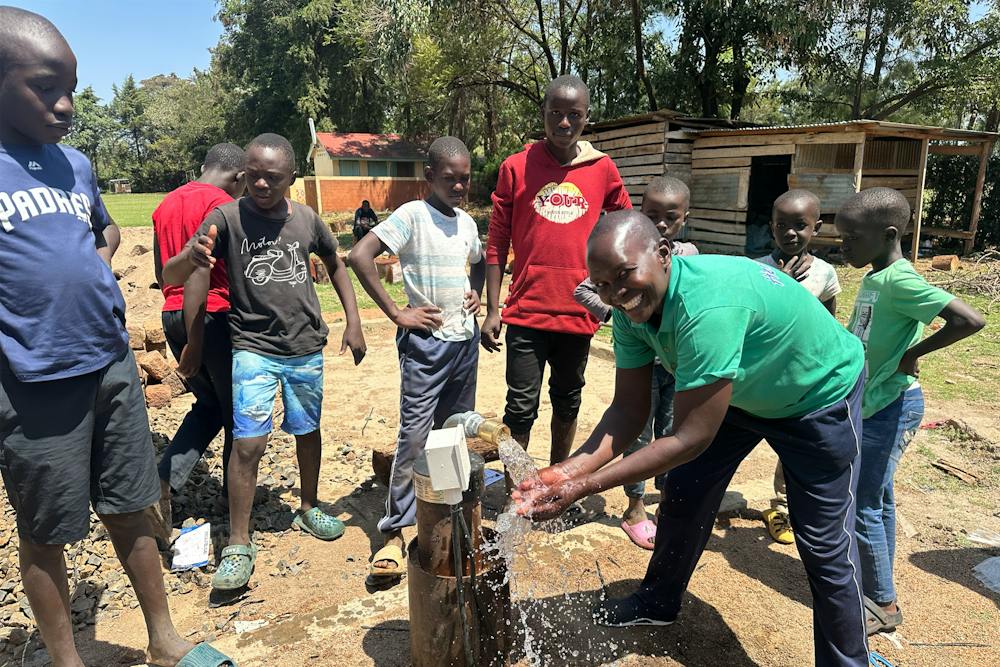
The chapter of Engineers Without Borders at ASU recently returned from a trip to Naki, a village in western Kenya, where they built a 600 foot deep, solar-powered well for a school of 500 students who had previously been drinking from a contaminated pond.
The well was completed in August and is the sixth project the chapter has undertaken in Kenya during its 14-year-long partnership with community organizer Noah Okidia. It's also the most expensive and technically demanding project the chapter has done in the area.
The region of Kenya where Naki is located gets "really intense drought seasons" leaving residents with unreliable water sources, according to Alex Miyamoto, a senior studying civil engineering and the project lead. Only 59% of Kenyans have access to safe drinking water, according to UNICEF Kenya.
Building the well
Before the installation of the well, students collected water from a seasonal pond also used by livestock, Miyamoto said. Some had to bring water bottles from home, while others used rainwater collected on the campus or from nearby shallow wells.
However, these options proved themselves to be unreliable during the seasonal shifts in rainfall. The time and effort required for students to access water sources increased.
"If the collection systems are dry, along with the shallow rain water wells, they have to walk to the nearby pond: about a 10 minute walk from the school," Miyamoto said in a written statement.
During extremely dry years, the walk can be over half an hour, Miyamoto said.
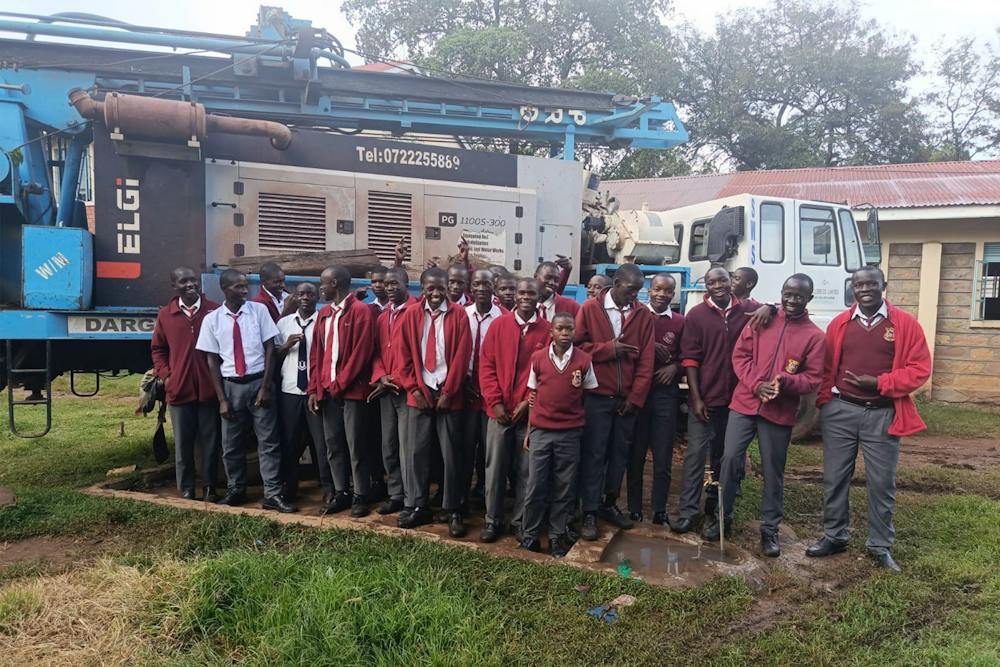
Drilling for the well required the help of a contractor hired by the club. A hydrogeological survey company assisted in finding the water table and implementing the borehole, where the clean water is stored said Jordyn Anderson, a sophomore studying aerospace engineering and the chapter’s prototype and documentation lead during the project.
The ASU team installed the piping, wiring and distribution logistics to get water from the borehole to a 10,000 liter water tower connecting to a tank at each school.
The $20,000 project was funded, in part, by a grant from the National Council of Examiners for Engineering and Surveying that sat dormant until Miyamoto located it last year. Prize money from Change the World, an annual ASU pitch competition, and company donations covered the rest.
When the project was completed, the water pump switched on and, at first, nothing came out. Then, the clean water gushed out — students crowded around, drinking from their hands.
"It was a really beautiful moment to see all the work that we had done that past year all come exactly to that one moment," Miyamoto said.
Planning for long-term maintenance
Miyamoto said that maintenance execution is the part of the project he cares about the most.
EWB-USA requires a formal follow-up process, and the ASU chapter’s work in Naki is nowhere near ending.
"A well-known problem with humanitarian projects is going there and then leaving," Miyamoto said. "You give them something really useful, but you don't equip them with the necessary tools to be able to maintain that project years down the line."
EWB-USA requires communities to cover at least 5% of a project’s cost. Households now pay roughly 200 shillings, equivalent to $1.55, into a monthly fund to cover the pump’s eventual maintenance.
The schools themselves are responsible for safeguarding the well system. Since the completion of the project, school leaders have added concrete protection around the exposed piping, and built a concrete enclosure around the main system.
If repairs are needed, a local engineer connected to the project's general contractor will be able to help decide and coordinate what maintenance needs to be done, Miyamoto said.
The chapter is also monitoring how much water the well produces. In the case that the well provides more water than needed, the team hopes to install an additional tap that could allow the school to charge a small fee per jerrycan, to make the project financially self-sufficient.
“We’re connected to that community, and we’re going to be keeping an eye on that system,” Miyamoto said.
Future improvements
The chapter has no intention to stop at clean water. The school also struggles with frequent brownouts, with power sometimes gone for days at a time, Miyamoto said.
Brownouts are not always full power outages. Sometimes, the electricity weakens or becomes unreliable because the grid cannot keep up with demand.
The secondary school houses boarding students who rely on electricity after dark, and the school is considering getting computers next year. Without reliable power, students would lose hours of studying and classroom resources.
"We're trying to figure out how we can get their electricity more sustainable because there's at least once a week their electricity goes out," Anderson said.
Next year, the chapter hopes to shift from a civil-engineering centered project to one focused more on electrical and mechanical work. The group plans to return to Naki, Kenya, next summer to check on the well, and possibly implement a source of solar power for the school.
An enduring partnership
Okidia has hosted ASU students in his home, and drove the chapter's Kenya team around on their first survey trip back in 2011.
"They're not living for themselves," Okidia said. "I look at young students going around and spending late nights to make sure that a project works in Africa for people that they did not even know."
He said he still doesn’t quite believe the outcome is real.
“I get home today, I draw water to take a shower without any problem,” Okidia said. “I drink water, clean water."
Edited by Alex Swift, Mia Sweador, Emilio Alvarado and Sophia Keeling.
Reach the reporter at lycifuen@asu.edu
Like The State Press on Facebook and follow @statepress on X.


