First established at ASU in 2009 with only eight teams and 35 students, Engineering Projects in Community Service has now grown into an expansive program with more than 60 teams— some of which have won national awards and turned into a variety of new and innovative community-focused companies.
Although hosted by the Ira A. Fulton Schools of Engineering, EPICS is open to students from all majors and intends to allow participants to help identify problems in communities, innovate solutions and gain real-world experience whilst contributing to lesser-served communities.
Projects range from designing dog bed storage racks for local pet shelters to a spacecraft that orbits an asteroid between Mars and Jupiter, so that we can learn more about the creation of Earth.
From large-scale international projects to smaller initiatives in the local community, EPICS impacts change while teaching its students skills that cannot be developed in a lecture-based environment.
Daniel Frank, an associate teaching professor with the EPICS program, was drawn to the impactful nature of the projects EPICS works on, no matter the size.
"How do you develop a low-cost incubator for rural communities in Ghana? That's a big problem," Frank said. "We've also had problems where, how can you develop a personalized feeding system for one tortoise thats shell is injured."
Recent student projects
Projects start in a variety of ways. Sometimes, it is a student or alum who brings an issue they have identified to the faculty, which develops into a new project. Other times, the faculty may find an organization or community that requires a specialized, engineered solution.
In the case of Neonatal Incubators For Ghana, Frank found an organization in Ghana through LinkedIn that had reached out to him for help with designing a lower-cost incubator system.
In Ghana, incubators are extremely expensive and rare to find outside of highly urbanized areas, which creates the risk of premature, low-birth-weight infants not receiving the care they need. EPICS faculty and students took the challenge on and are currently working to develop low-cost incubators while dealing with temperature and humidity control factors.
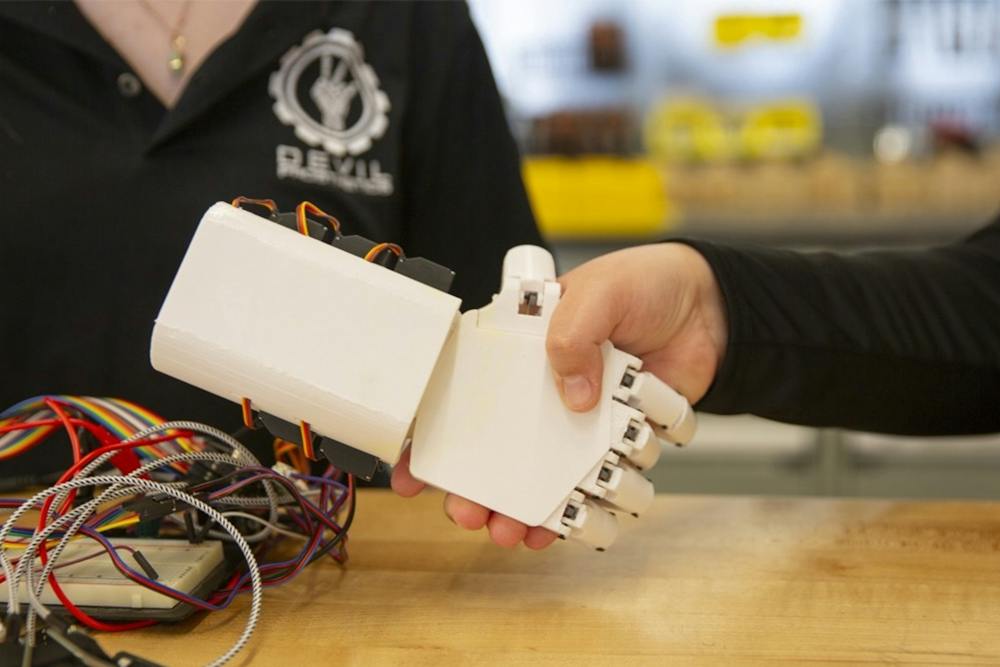
Devil Prosthetics – Piece by Piece Prosthetics is another project that aims to innovate affordable and functional prosthetics for children who have suffered traumatic injuries that resulted in amputations.
Laynie Ben, a senior majoring in aerospace engineering, started working on this project with her team when they realized that there was a gap in the prosthetics sector.
"Either you had an affordable prosthetic that didn't really do much and was often abandoned at a higher rate compared to adult prosthetics," Ben said. "Or you had a more expensive prosthetic with better functionality, but it would often be a one-size deal, so, when the kiddo would have a growth spurt... the prosthetic wouldn't fit anymore."
While first conceived in an EPICS classroom, the students realized they required a better 3D printer, which led them to participate in multiple funding competitions. The team won over $10,000 in prize money and eventually formed their own company, Piece By Piece.
READ MORE: EPICS: How Sun Devils are engineering change
Why is EPICS unique?
Ben said she developed unexpected skills through her experience at EPICS that she might not have learned otherwise.
"I learned more project management skills, I learned more technical skills, I got more familiar with applications that I wasn't necessarily used to in order to better the project," Ben said.
Alicia Baumann, professor and assistant director of EPICS, said the program teaches students to think critically, troubleshoot problems and gain exposure to communities and demographics that they might not interact with in the classroom or professional world.
Solutions often do not consider these lesser-served communities, which are often the exact populations that do not have the means to seek out specially-engineered solutions.
Baumann said the experience not only makes a difference to these communities, but to the world as a whole, by helping create engineers who set out to solve problems with a humanitarian approach.
"Technology will always evolve; the solutions are going to get greater, the problems are going to get bigger," Baumann said. "But if you understand how to look at people and solve and have empathy for what they need, you can be able to solve any problem in any generation that we're in."
Edited by Mia Sweador, Alan Deutschendorf III and Sophia Keeling.
Reach the reporter at agferna9@asu.edu.
Like The State Press on Facebook and follow @statepress on X.