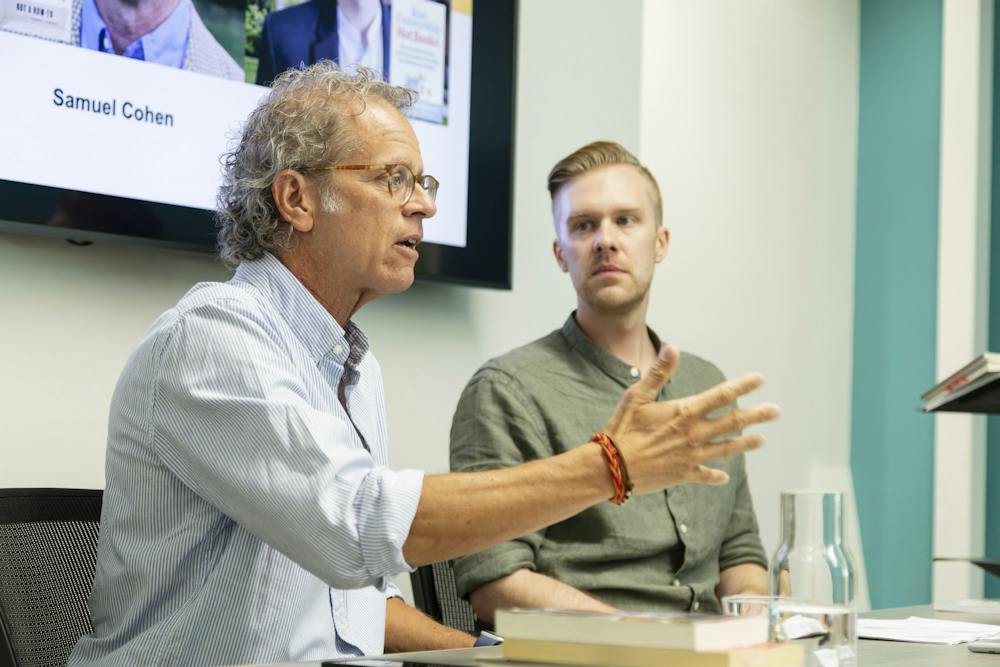
On Wednesday, ASU's Humanities Institute hosted English professors Josh Coleman and Samuel Cohen for a workshop about the harms of book banning in K-12 schools and universities.
Coleman, a professor in the University's Department of English, and Cohen, a professor at the University of Missouri, spoke about their respective studies in book banning and the books they have both published on the topic.
Coleman's book, "Ban Censorship, Not Books," is a collection of stories from educators detailing their experiences with book censorship.
Similarly, Cohen's book, "Banning Books in America: Not a How-to," gathers the experiences and opinions of activists, writers and literary advocates on book banning.
While Coleman said there is no book that is illegal to buy in the United States, he believes the problem lies in access — especially for younger students.
"Increasingly over the last six years there are more and more ways state legislatures can make it harder for kids to get their hands on books," Coleman said.
One such way Coleman spoke about was "opt-in" laws, where parents have to give written permission for their children to be able to read certain pieces of literature — generally works that involve varying degrees of sexually explicit content.
"It's not just that parents have the right to opt out of certain kinds of instruction and certain kinds of reading, but the requirement to make every student opt in," Coleman said. "Every parent signs a form saying 'our students can read this horrible literature.'"
Recently, the Peoria Unified School District removed authors such as Frederick Douglass from middle school classrooms, which Coleman said was an indicator of declining intellectual freedom.
But book bans don't solely impact K-12 institutions. Coleman said the consequences of these policies can affect the crucial backbone of academic freedom inherent to a university.
"Book bans, ultimately, are things that can sort of trickle up in a particular sense to impact students at the university to take away their capacities to engage in different stories — the stories of people of color, queer people, trans people," Coleman said.
Cohen said the potential scrutiny tied to teaching banned books can push professors away from teaching content that deals with race, sexuality and other marginalized backgrounds.
READ MORE: BREAKING: DOJ launches investigation into ASU over alleged DEI violations
For Coleman, this pressure can take the form of soft or indirect censorship, such as changing a course title or choosing not to add a book to the syllabus because of events happening around the school.
Chris Hanlon, a professor of U.S. literature at ASU, was in the audience for the workshop. He said he's seen how institutional attitudes can change over time.
Hanlon said that around 25 years ago, a former student of his refused to read Edmund White because of White's identity as a gay man.
Although the student went to the chair of the English department about the assignment, she ended up coming back to Hanlon to apologize for her behavior, he said.
Hanlon said attitudes among university administrations about how to handle a similar situation may have changed since.
"There might be a bit more reluctance to confront a student like that and to explain to them that they don't have a Ph.D. in literature, they don't have experience designing curriculum," Hanlon said. "Maybe they should suspend disbelief and take the class as it is."
READ MORE: As third spaces, ASU libraries are stacked with more than just books
Whether or not administrators step in, Coleman has focused on fighting book bans through his "local resistance framework," which focuses on helping teachers identify their agency in book ban situations.
"What (the framework) is really inviting folks to do is to understand where they're teaching, what they're teaching and what are the strictures that surround them," Coleman said.
But for Hanlon, the responsibility doesn't just fall on teachers.
"At times like this, it's the obligation, not only of faculty, but of college administration to dig in and stand up to people who would deprive students of the opportunity, for example, to read Frederick Douglass," Hanlon said.
Edited by Sam Troester, Alex Swift, Carsten Oyer, Grace Lawrence and Sophia Keeling.
Reach the reporter at omoranwi@asu.edu.
Like The State Press on Facebook and follow @statepress on X.