"If you want to sign up for the wet T-shirt contest, go tell the short Asian guy," the emcee says in the middle of the grand opening crowd at Import Life, a new custom car performance shop in Phoenix.
Snickers can be heard from the mid-afternoon crowd, and the emcee laughs at his obvious joke. The crowd is comprised nearly all of Asian guys ... short Asian guys.
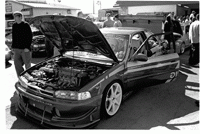
Besides gawking at the hosed-down girls on the makeshift stage in front of the shop Saturday, these some 500 onlookers mill around, admiring elaborate paint jobs, shiny engines reflecting the sun under popped hoods, and eccentric interior details (like front seat TV/DVD combos and computer control panels).
Gustavo Herrera, 21, leans back on the blue-and-yellow Honda Accord he's been working on for the last year and nine months.
"It's a good way to express myself," he says, explaining the reason he invests so much time and money into his car. Herrera has spent over $12,000 adding on features, such as ground effects, a roll bar and a Playstation II.
Phoenix's world of high performance cars has attracted much attention lately, from Hollywood and from the Capitol.
The glitz and glamour of illegal street racing was captured in last year's blockbuster The Fast and the Furious, which was based in Arizona.
Meanwhile, the potential danger of the sport has come to the forefront of local legislature as Democratic Sen. Kathi Foster fights for an anti-drag racing bill, spurred on by the death of her nephew who was killed in an accident caused by a drag racer.
Police attention has been attracted, too, since a high-speed collision in Scottsdale on Feb. 28, leaving three dead, has a speculated connection to racing.
The increasing amount of attention, both positive and negative, paid to this sport enforces the allure of this custom car subculture.
New shops, like Import Life, springing up around the Valley are measures of the hobby's popularity.
General manager Victor Santana, of Apex Motor Sports in Tempe, the shop which has been a mainstay of the ASU customizing community for seven years, says their clientele has stayed consistent but that more specialized shops are opening.
"There's more competition now," Santana says. "Mitsubishi just opened a shop in Scottsdale that's a little more performance oriented, and HTA and Versus are two other stores (that have recently opened)."
Apex typically works on six or so cars a day, which, according to Santana, are mostly Hondas. Modified Hondas are the most frequently street-raced cars.
And of all the alterations he does, the most popular is increasing cars' speed capabilities. His shop, like most, has no caps on how fast workers will make a car go; he mentions that it is up to the owner to be responsible with the speed of their car.
"I think every car that comes out of the shop...is going to provoke somebody to have a race," Santana says. "We don't promote it.
"Seventy-five percent of the (altered) cars on the street shouldn't be out there," he says. "But we have to sell the stuff."
Brian Climaco, a 23-year-old Glendale Community College student, is currently working on a 1993 Civic hatchback that he has had since last April. He has exchanged the front end and the dash with parts from a 2000 Civic and the interior of an Integra. It is the seventh car he's worked on since he first got started in customizing at age 15.
Climaco works on a team called 4N Speed, a group of 15 friends from Arizona, with some associate members in Hawaii and Illinois.
Perks of being on a team, rather than working on your car independently, Climaco says, include having "more people to troubleshoot for you. We all help each other out."
The group has been around since 1994, experimenting with new styles and techniques of customizing. "We always try to be the first," Climaco says. "We just want to be innovative...Most racers know who we are."
4N focuses on imports, which Climaco explains, challenge those who are more into technical customizing. Imports, Climaco says, are vastly different from domestics.
"Domestics, to me, look like they're giving off the tough guy attitude, trying to look like Happy Days or the Fonz," Climaco says. "They're just more showy."
"(At street races) people with domestics are always doing 180s and figure 8s; that sound attracts attention."
And, as far as street racing goes, attention is the last thing you want. Climaco says that while he has never been caught street racing, the danger is always there. "The cops are everywhere," he says.
Sgt. Randy Force of the Phoenix Department of Public Affairs says that, though illegal street racing is not a huge problem for Phoenix, it does happen.
"There are two or three industrial areas where kids race on nights and weekends where we send some enforcement action out," Force says.
So why do people race on the streets when there are sanctioned legal tracks like Firebird and Speedway in the area?
Matt Farmer, a recent ASU graduate, said he's been to a handful of illegal races, some which have drawn, from what he remembers, 600 to 700 spectators. He says it's the thrill and the danger that draw the crowds and the racers.
"It's like a horse race, you pick a favorite and you cheer for them," Farmer says. There is an environment in the late night illegal races that you can't get at the tracks. "There is a smoky type atmosphere from the car exhaust," Farmer recollects, "and when the cars go by everyone runs into the street."
Climaco agrees that there is a definite feeling captured in the streets, and that it isn't only the race itself, but the entire experience.
News of a race, he says, usually spreads around by word of mouth, without clear directions or a definite location. No rules apply for what Climaco calls night races, which are more commonly known as "illegals."
"It's totally unorganized, but it's fun," he says. "People will be on the side of the road playing loud music and some guy will start flagging cars on, then someone will come up to you and say 'my car is better or faster than yours' and then you race them."
He says his favorite part of the hobby is when he gets recognition from other people who are genuinely interested in the sport.
"My favorite memories are when I beat somebody on the street, they asked me to pull over and they congratulated me on my car," Climaco says with obvious pride for the countless hours of work he has put into his vehicle.
"That, and hearing your team's name all over the place and knowing that people have heard of us."
He looks fondly back on the street races, which he doesn't participate much in anymore.
"It's not that I've outgrown them," Climaco says. "They've outgrown me. They're too wild now."
It's a different mentality today, he says. Poor attitudes have focused these events more on rivalries than on races.
With increasing instances of violence, Climaco notes that sometimes people are too scared to even go watch the races.
"At a street race people just want to prove things in front of all kinds of other people," he says. "As money isn't typically involved, many people race solely for the status that winning brings. Track racing, which may not be as risky and glamorous, is what you do to prove your skill to yourself."
Reach Jessica Wanke at jlwanke@hotmail.com.