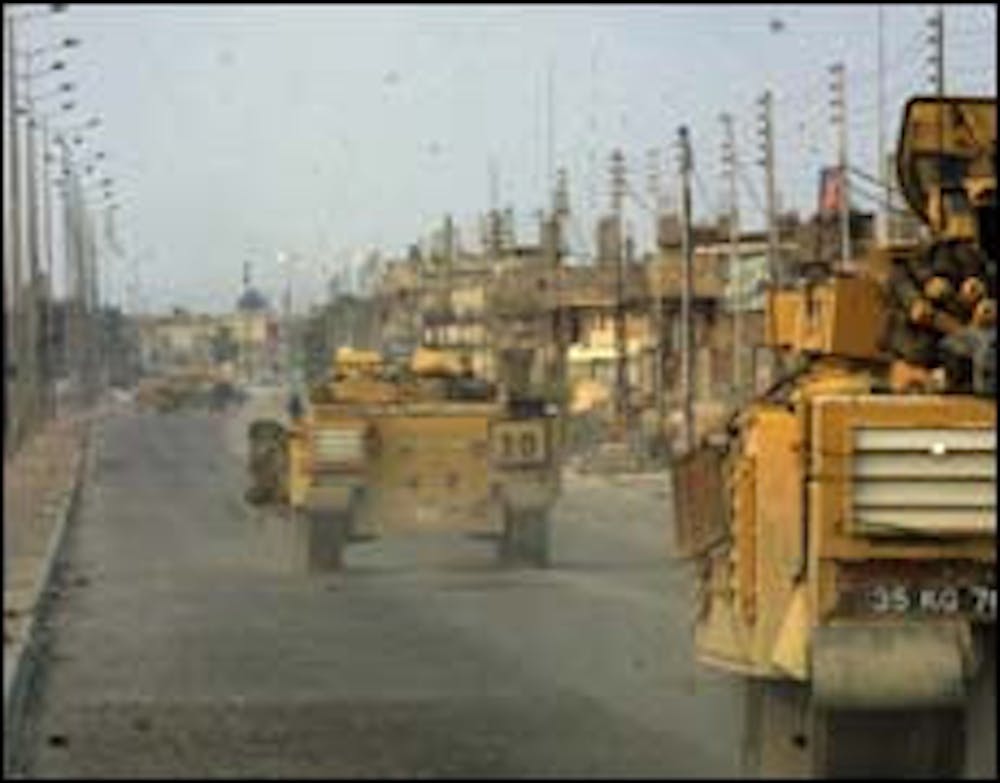
BASRA, Iraq - Hundreds of British troops and dozens of tanks and armored fighting vehicles pushed into the center of Basra on Sunday, sending Iraqi military and Baath Party officials fleeing but also setting off a looting spree in the newly lawless city.
After bombarding southern Iraq's largest city for much of the 17-day war, the British army met little resistance in taking "large parts" of Basra from Saddam Hussein's forces, who apparently "melted away" or fled north, officers said.
Beside the main road into this city of 1.3 million, some residents cheered. Others rode the highway out of town - many of them looters stealing anything they could tow, and some Baath officials attempting to sneak away.
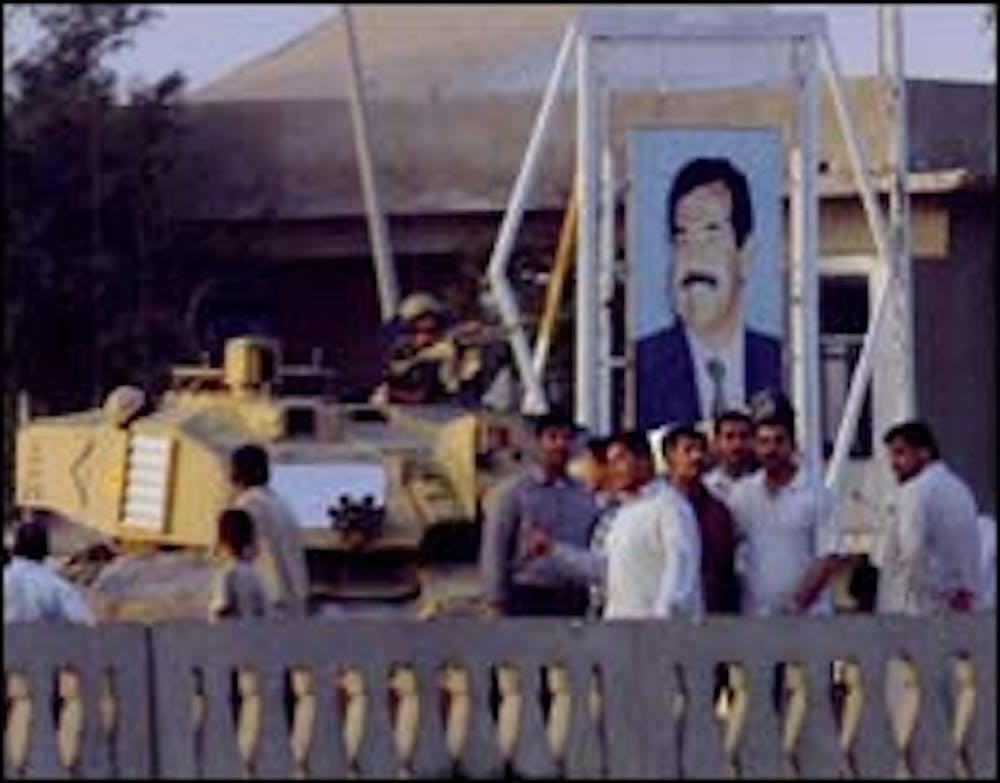
A line of tanks and armored troop carriers reached Baghdad Street, near the city's center, initially prompting panicked residents to flee. But by Sunday evening, many were headed home again.
"It's finished," said Kalaf Hassan, a butcher in the city. "Now it's safe."
British commanders, careful to avoid house-to-house fighting that might bring high casualties, had ordered a series of probing attacks in the last two weeks, seeking to identify enemy positions. Sunday's attack began as a similar probe, but when British forces encountered light resistance, they decided to move in more forcefully, officers said.
In securing the southern half of Basra Sunday afternoon, no allied casualties were reported, and the British said they were expecting the entire city to fall in the next day or so.
The attack began Sunday morning when helicopters swept over the city, attacking a Baath Party headquarters and parts of the north end of the city, residents said. On the ground, soldiers seized a military hospital at the center of Basra and surrounded a group of Baath leaders in a government house, according to an Iraqi army soldier who deserted his unit Sunday morning in the face of the British push.
"They have four big men of the government surrounded," Muhaned Hussein, 25, said as he fled past an allied checkpoint out of the city. "I saw it just now as I was trying to get out."
Eyewitnesses said Baath Party officials and Iraqi militia members were throwing off uniforms and trying to escape by foot and bicycle. Some Iraqi fighters in civilian clothes shot Kalashnikov rifles at residents trying to flee the city, Hussein said.
Most Baath Party officials had vanished. And residents insisted that foreign fighters brought in to back the Iraqis - including Syrians - had fled their positions. "There's nothing left of the soldiers or the Baath now," said one man who declined to give his name. "They've changed clothes and run away."
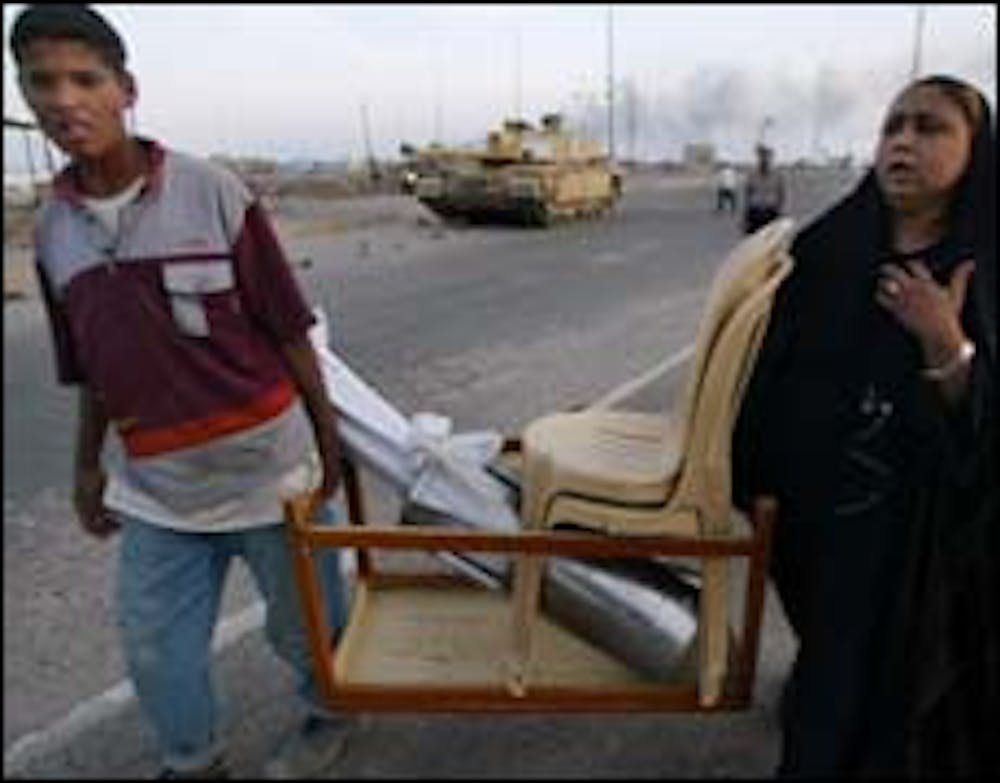
Families escaping Basra said looters had taken to the streets as Iraqi forces fled, breaking into a supermarket and other shops. Trucks headed out of the city Sunday afternoon carried groups of young men atop piles of new truck tires, still in their wrapping.
Other trucks emerged from the city laden with water pipes, air conditioners and auto parts. One man in a tractor was seen exiting the city several times - with a different car in tow each time.
"Everyone is stealing everything they can find. People are destroying the city," said Ali Mohammed, an Arabic language student at Basra University. He said looters had also broken into the university and were carting away classroom contents.
"How will we go to school now?" he asked. "The U.K. soldiers are the ones attacking, but it is the people who are destroying the city.
"This war needs to get over soon."
Many residents said they were grateful that allied forces were seizing Basra, and said they hoped that control would quickly extend to Baghdad. But they said they were disappointed at the lawlessness that had come with the military push.
"My heart breaks when I see my city destroyed," said one man, carrying a load of fish out from the port city. "I don't like Saddam Hussein. But this is not right."
One well-dressed man, who stopped along the road out of town, complained bitterly that Iraqi religious leaders needed to speak out on television and radio and appeal for calm and a stop to looting in Basra.
"I can't believe what's happening in this city," he said.
In the back of his aged white pickup, however, sat two window air-conditioning units and a copy machine. Asked where they had come from, he shrugged. "My family will eat from these machines," he confessed.
As allied helicopters swept low over central Basra, the sound of low explosions echoed in the distance. Cars bearing Iraqi government plates were among those rushing out of the city. Many passed with hands protruding from the windows, waving whites pieces of fabric.
Travelers leaving the city said residents had broken into the main prison and freed everyone still held behind bars.
Along the highway into the heart of Basra, trucks and streetlights lay upended beside crater blasts. The straight desert roadway into the city's south end offered a bleak palette of grays and charcoals in a place renowned for how its waterways transform desert crust into lush greenland this time of year.
In a park of palm trees near an intersection with Route 6, a whimsical sculpture of a leaping 20-foot dolphin had its back blown off. A block away, tall black smoke rose from an explosion near a mosque surrounded by several British armored Warrior vehicles.
At one British checkpoint in the highway median, an Iraqi man about 30 years old sent soldiers scrambling as he approached. They escorted him inside an armored vehicle, where he complained about a stolen vehicle. They quickly sent him off - after ensuring the car he arrived in was free of possible bombs.
Unlike the lush roadside marshes filled with songbirds on the outskirts of Basra, the city's interior contained long stretches of lifeless lots where nothing grew in black pools of oil or stagnant water. Outside one factory, an oil fire apparently set by Iraqi militia to screen their firing positions drenched the air with filth.
But for the first time since the war began, residents began cheering and gesturing thumbs-up. Saddam's enforcers had battered and punished those who publicly supported the invading U.S. and British forces, but that atmosphere largely vanished on Sunday.
"Very good, Mr. Bush!" said one man driving his wife and children in an orange-and-white cab that was converted to a family vehicle, a common Iraqi practice.
In recent days, Saddam reportedly had dispatched some of his better-prepared forces from the Republican Guard to defend Basra.
But by Sunday evening, two British battle groups, with a third in reserve, were advancing block by block in a pincer-like movement within Basra. They had yet to face the house-by-house guerrilla warfare that they had feared from Iraqi's Republican Guard, militia and paramilitary Fedayeen fighters.
Allied commanders had expected a civilian uprising against Saddam in Basra, and that was one reason they held off making a major assault. But Iraqis in the south said they weren't going to stage an uprising until they were convinced that Saddam was ousted from power.
On Sunday, with the British on the offensive, a clear sense of optimism already had begun to settle in.
"All the regime of Iraq has run away," one man yelled from a passing car on his way out of town. "We're free now. We hope Baghdad will be next."
© 2003, Chicago Tribune.
Visit the Chicago Tribune on the Internet at http://www.chicago.tribune.com/
Distributed by Knight Ridder/Tribune Information Services.