BURLINGTON, Vt. - In Howard Dean's presidential campaign, the power of his money is measured in not just dollars, but cents.
When Al Gore endorsed Dean's candidacy, supporters contributed $695,658.75. After a group of fellow Democrats aired attack ads, donors defended him by pledging $552,214.62. Even on Halloween, Dean admirers gave $354,891.48.
The contributions, calculated down to the penny, offer a glimpse into the former Vermont governor's creative money-raising machine that has overwhelmed his rivals and changed the course of the 2004 presidential race. As part of Dean's unconventional strategy, some donors add an extra 44 cents because they hope Dean will become the 44th president, while members of Generation Dean, a teen-age group, give an additional 18 cents to show that young people are donating money.
The loose change, of course, accounts for only a sliver of Dean's record-setting Internet fundraising that in a recent 17-day period generated nearly $3 million. But the nickels and dimes come attached to larger contributions of $100 or $200, which swell every time the campaign launches a fundraising challenge.
The power of Dean's money has allowed him to launch a multi-million dollar advertising campaign in a half-dozen states and deploy workers to 18 more. Why devote such time and attention to a national effort, while most candidates are still focused on January's contests in Iowa and New Hampshire? Because he can.
Less than one month before the 2004 presidential selection process begins on Jan. 19 with the Iowa caucuses, several candidates are redirecting money from other states and pouring virtually all of their resources into Iowa as they struggle to compete with Dean and stay afloat. If the money well runs dry, staying alive is difficult.
"It's like Pavarotti with laryngitis. You can't reach your audience. You become invisible," said Bob Kerrey, a former Nebraska senator whose 1992 Democratic presidential bid was cut short after he ran out of money. "It's brutal if you don't have money, because your opposition has so much more capacity than you do."
Two weeks ago, Sen. John Kerry of Massachusetts loaned $850,000 of his personal wealth to his campaign and last week took out a loan of more than $6 million against the value of his Boston home. Sen. Joe Lieberman of Connecticut urged his staff to voluntarily delay one of their January paychecks for a month. And Rep. Richard Gephardt of Missouri asked his top aides to permanently cut their salaries so he could keep running TV ads.
"Dean is out-raising the Democratic field combined," sighed a senior aide to one of Dean's leading rivals. "If this were a track race, you would have a pack running in a dead heat with Dean coming close to lapping the field."
Only Wesley Clark, the retired four-star Army general who joined the race in September, is coming close to reaching Dean's fundraising prowess among Democrats. Aides said that in the three-month period ending Dec. 31, Clark is likely to raise at least $12 million.
It is Dean, though, who has caused the most frustration for rivals struggling to raise even a third as much money. He changed the race's dynamic last month when he became the first Democratic candidate to abandon the public financing system, so he could outspend his Democratic challengers and prepare to take on President Bush, who is on his way to building a war chest of nearly $200 million.
These days, most everywhere he travels, Dean has a professional blue backdrop and stage lighting that transform places like a school cafeteria into a picture-perfect political setting. By contrast, Gephardt has a fading, hand-painted sign hanging from the roof of his Iowa campaign headquarters.
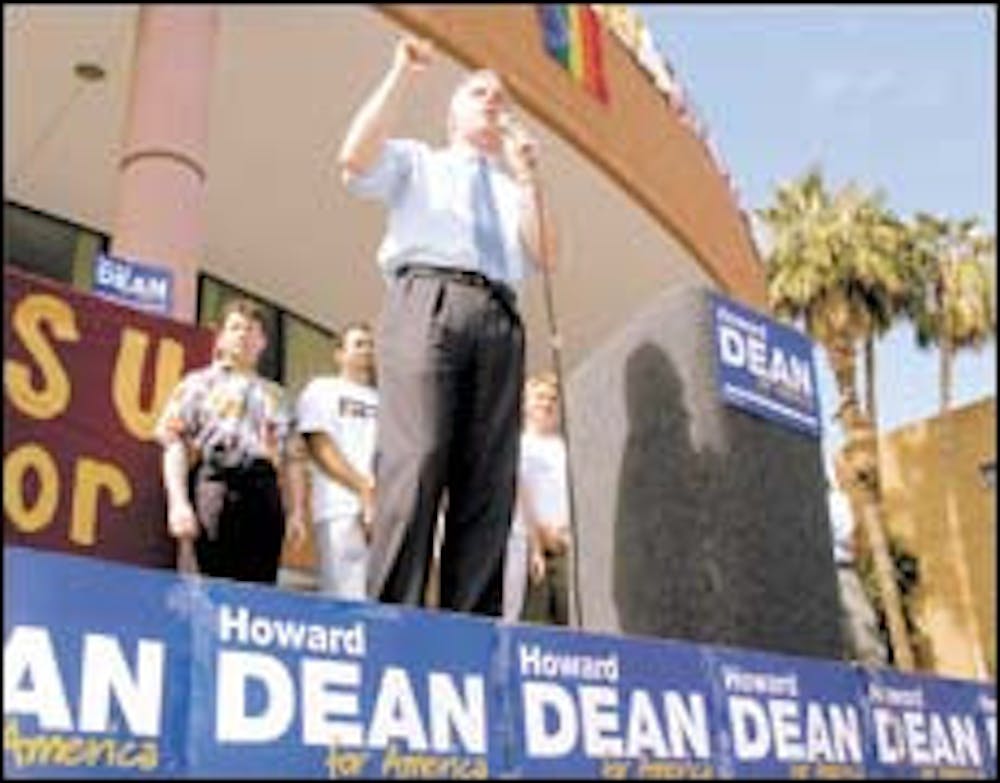
At events across the Southwest last week, Dean was surrounded by "Arizona for Dean signs." At one stop in Yuma, Ariz., fans greeted the candidate in their personalized shirts, with the message: "Yuma for Dean."
But more important than T-shirts and professionally-printed signs, money buys added muscle in the form of campaign literature to target undecided voters, as well as more phone banks for volunteers in states across the country that are far down the nominating calendar.
"You're not going to be able to win public office without a good campaign organization and one of the prerequisite of a good campaign organization is the ability to raise money," said Jim Pederson, the chairman of the Arizona Democratic Party. "And Governor Dean has exhibited that in spades."
To be sure, countless well-financed presidential candidates have failed to turn sizeable money advantages into real support.
When former Sen. Phil Gramm of Texas joined the 1996 Republican presidential race he bragged, "I have the most reliable friend you can have in American politics, and that is ready money." But the voters thought otherwise, prompting him to drop out of the race before the New Hampshire primary. And Republican Steve Forbes, in 1996 and 2000, offered lavish sit-down meals and took professional photographs with prospective voters, but his self-funded candidacy never took off.
Here in Vermont, where Dean's crowded campaign headquarters churns around-the-clock on the third floor of a brick office building, the task of watching Dean's Internet fundraising is assigned to Nicco Mele, the campaign Webmaster.
On Dec. 9, the day Gore endorsed Dean's candidacy, the telephone ran on Mele's small desk every 20 minutes. It was campaign manager Joe Trippi, calling back to headquarters with the same question for the 26-year-old: "How we doing on money?"
Each time the campaign launches a fundraising challenge, Mele places a baseball bat on the "Dean for America" Web site. Often, it is Dean's own supporters who demand the "bat," which has developed a game-show like following, that encourages people to contribute money instantly through their credit cards. The bat fills up like a thermometer to indicate the campaign's progress.
The $500,000 goal of the Gore-endorsement fundraising drive was surpassed in two days. By the time Mele removed the "bat," the tally had reached nearly $700,000.
On May 14, shortly after Mele joined the campaign, Dean's supporters contributed $1,950 on the Internet. A typical day last week drew about $80,000.
"It's like an inspiration," Mele said, his laptop computer on his knee, checking the latest figures. "I'm always surprised by this."
While all candidates raise some money through their web sites, no other campaign has been able to match Dean. Not only are his rivals envious by the amount Dean has raised, they also are flummoxed by the low-overhead and the speed at which Dean will be able to replenish his coffers after the early primaries and caucuses, when other contenders are broke.
Still, many voters are undecided in the early-balloting states. If Dean loses Iowa or other early contests, his campaign is already thinking up new fundraising drives to quickly raise the money he needs. And those challenges, too, will be counted in not just dollars, but cents.
©2003, Chicago Tribune.
Visit the Chicago Tribune on the Internet at http://www.chicago.tribune.com/
Distributed by Knight Ridder/Tribune Information Services.


