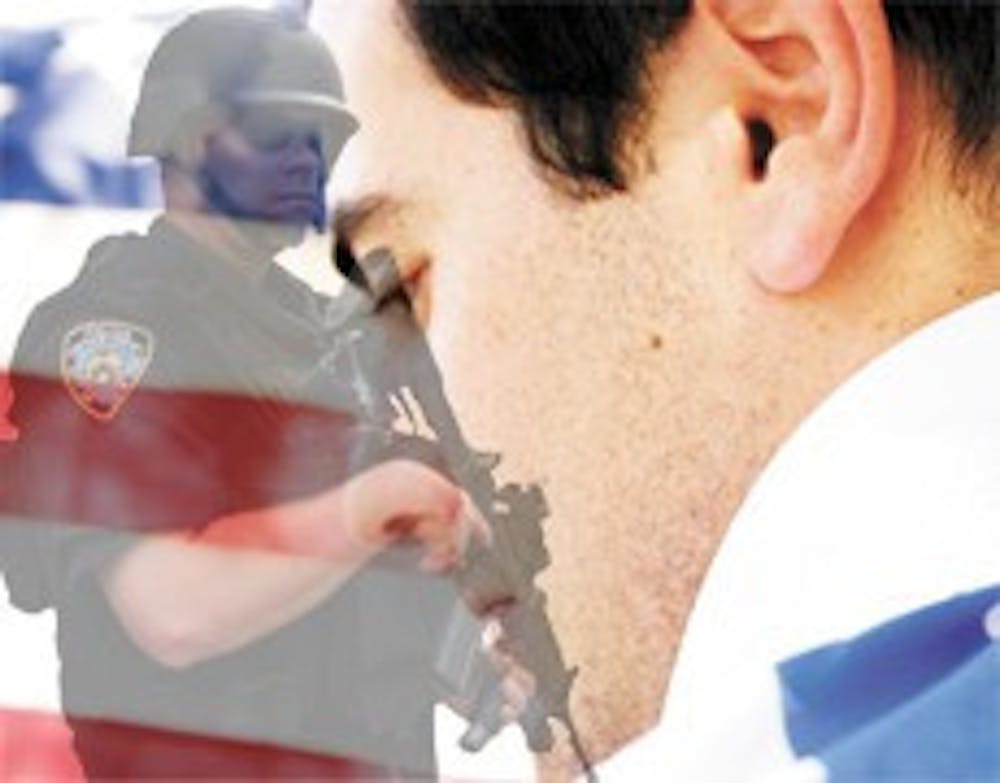
ASU student Josette Madonia was at work on Sept. 11, 2001 when she heard the news.
"I was shocked and sad when I heard on the radio that an airplane had hit the World Trade Center," Madonia, a 32-year-old Tempe resident, said. "It was so emotional that I didn't want to watch the images on TV until a week later."
Since that day, Madonia has feared another terrorist attack on U.S. soil. She follows the news every day on TV and the Internet.
"It makes me sad to hear about terrorist attacks anywhere," she said.
Madonia, who graduated from ASU in 2003, is like many students who have to live every day knowing they could see another attack like Sept. 11.
This November, students will have a say in how America fights back against that threat. President George W. Bush and Sen. John Kerry have different perspectives on how to fight the war on terror, but it is the victor in the upcoming election whose ideas will be implemented as U.S. policy.
War on Terror
Madonia said she is glad Bush made policy changes in response to Sept. 11, such as heightening airport security, but she thinks he has pushed the war on terrorism too far.
"I strongly believe that we should go after the terrorists responsible for the Sept. 11 attacks," Madonia said, "but if we are going to have a global fight against terrorists, as Bush keeps saying, then our allies should join us."
While Madonia and others criticize Bush's policies on terrorism, Kevin J. Cooney, a political science professor at Union University in Tennessee, said that little is likely to change if Democratic candidate John Kerry wins in November.
"Kerry does not want another Sept. 11 attack any more than Bush does, so he will keep most policies in place," Cooney said. Kerry would try to mend U.S. relations with France Germany and other allies if elected to office, Cooney added, but "none of our old allies are likely to commit support for Iraq to help Kerry out any more than they would for Bush."
According to Cooney, a former ASU professor, Bush's greatest policy achievement has been pursuing those believed to be responsible for the Sept. 11 attacks. This strategy, Cooney said, makes it much harder for terrorists to attack the United States.
Bush takes the offensive by going after any potential threats to the United States, while Kerry's strategy would be more defensive in nature, Cooney said.
"This is the major difference between Bush and Kerry's policies on terrorism," he said. "While neither wants another Sept. 11 attack, Bush is more willing to use U.S. power to remove potential threats, even at the expense of our global reputation. Kerry would be more likely to trust intelligence and law enforcement to thwart attacks before they could be carried out."
According to a Washington Post-ABC News poll released Aug. 31, 60 percent of registered voters approved of Bush's handling of the U.S. campaign against terrorism. Thirty-seven percent disapproved, and 3 percent expressed no opinion. The poll of 1,207 adults selected randomly nationwide had a margin of error of 3 percent.
Sheldon Simon, an ASU political science professor, said polls show that Americans are relieved there has not been a repeat of Sept. 11.
"The war on terrorism is probably the single most important issue because it has to do with what the country views as a vital threat to its national security, and that's because of Sept. 11," Simon said. "The Bush administration is trying to show that it has the best policy to deal with terrorism, that its leader is strong and tough and able to stay the course, and that a large number of voters feel that way."
The Patriot Act
The U.S. Patriot Act, enacted less than two months after Sept. 11, gives law enforcement agencies unprecedented tools to combat terrorism.
The 342-page act expands the government's power to conduct secret searches, keep taps on Internet and phone conversations for intelligence purposes and gain access to financial information and student records that would ordinarily be confidential.
Kerry said some of the provisions of the Patriot Act should be reviewed, including the investigation of a citizen's reading habits at public libraries, according to an Associated Press report published Sept. 7.
In the same report, Bush said no single civil liberties violations have been cited by the inspector general, who advises the Department of Defense on issues of abuse and fraud.
But critics of the law, such as the American Civil Liberties Union, believe the act is too broad and violates citizens' rights protected by the Constitution.
Josette Madonia said the act is one example of Bush pushing the war on terrorism too far.
"I initially felt he was heading in the right direction, but with the passage of the U.S. Patriot Act, I feel this is a big violation on my civil liberties," she said.
Madonia doesn't want the federal government checking up on what she reads. "This law was passed in the heat of the moment," she said. "People might not want to check out a book because the federal government might be checking them out."
Student concerns
Chris Moysset, president of the ASU Young Democrats, said the war on terrorism is not one of students' main concerns in this election. Instead, tuition increases, job availability and the war in Iraq top the list. Students have to endure yearly tuition hikes, and once they graduate, they struggle to find jobs in "Bush's economy," he said.
"People our age are fighting and dying in Iraq and Afghanistan, too," Moysset said. "It seems that having these personal connections to issues has engaged students in a way they haven't been before."
Bush's "go it alone" foreign policy has alienated America's longtime allies, he added. Kerry wants to build U.S. military strength by incorporating other nations into a system of alliances.
"We can build on our military strength by working with other nations and using diplomatic capabilities," Moysset said.
Jared Sandella, chairman of the College Republicans at ASU, offered a different view. Although Kerry says he supports the military, he has repeatedly voted against funding U.S. troops in combat.
"The president will not wait for new threats to grow and fester," Sandella said. "He will face new challenges swiftly, surely and with steely resolve. We cannot forget that the terrorists remain determined to kill as many Americans as possible, both abroad and here at home, and would like nothing more than to use the world's most deadly weapons against us."
Madonia said Bush may be a strong leader, but he's leaving U.S. allies in a position where they have not supported the country.
"Because of these concerns, I plan on voting for Kerry," Madonia said. "He would help us win this war, and at the same time, reinstate the reputation of the United States with the world."
Kim Grozek is a graduate student at the Walter Cronkite School. Reach Grozek at KGROZEK1@aol.com. La Poasa is the politics reporter for The State Press. Reach Poasa at laosamoa.poasa@asu.edu.