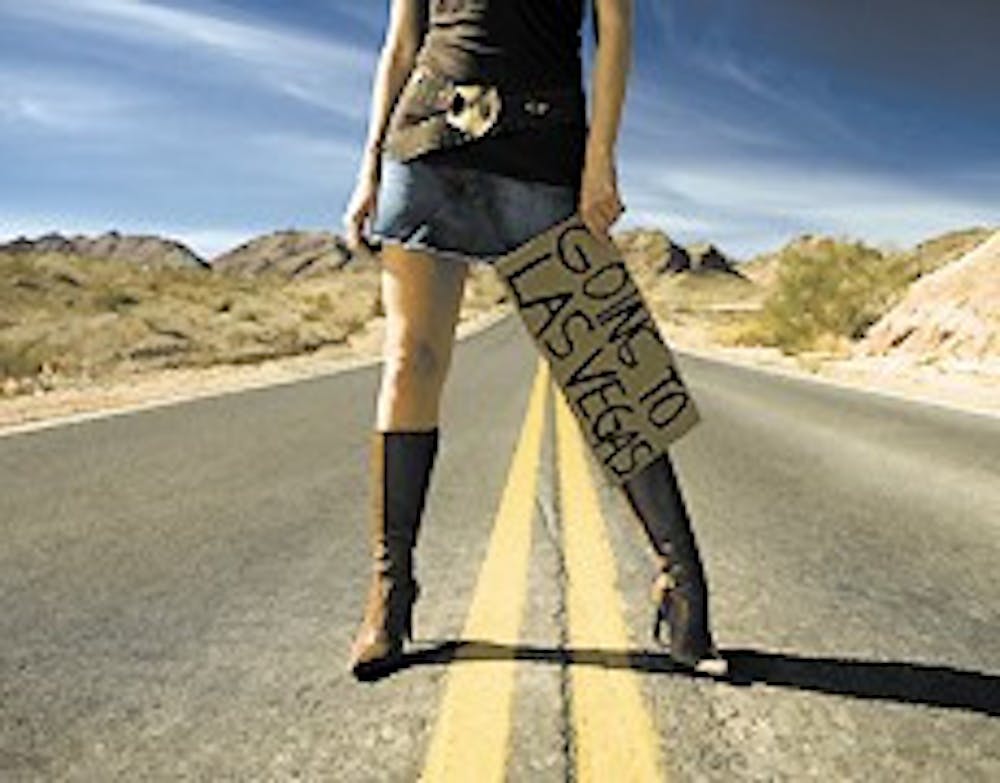
In a completely different world on a highway 50 years ago, travelers stopped at a nameless gas station to fill up their tank. The driver might buy a 25-cent bottle of coke, or he might give some wide-eyed kid a free ride.
Extremely economical and pleasantly unpredictable, hitchhiking let those without the means to travel do so. In the past, many adventures were documented — most famously by American writer Jack Kerouac.
Kerouc's friend Neal Cassady, Guiness' record hitchiker Devon Smith and revolutionary Ernesto "Che" Guevara followed suit. Even politician Ralph Nader says he hitchhiked frequently in the '60s in his book, "The Good Fight."
"It was Kerouac who would define, eloquently, that nagging secret itch many young Americans were feeling and send so many of us out in search of that elusive right in our own country," Joyce Johnson, Kerouc's longtime friend writes in "Smithsonian" magazine in 2007.
But then, "The Texas Chainsaw Massacre" happened. And "The Hitcher" happened. Twice.
And whether it was the effect of watching hitchhikers get killed off in films or simply a change in attitude in America, the hitchhiker disappeared. Or, at least, become more of a rarity.
However, last summer, business management sophomore John Taska stuck his thumb out and asked for a ride.
"It's about innovation," Taska says. "If you're stuck in Bumfuck, New Mexico, you're forced to be your own innovator. It's a game."
The world of Kerouac is miles away, and the act of hitchhiking is reserved for the truly penniless or for sociopaths and their victims. A few students, however, are attempting to bring the hitchhiker out of hibernation.
Taska isn't penniless. He's fairly well-groomed. He's an all-American guy and not a sociopath.
He says hitchhikers interact with their surroundings more than other travelers.
"You're forced into social interaction," Taska says. "If you stay in a five-diamond luxury hotel, you don't talk to the person serving your drink."
Taska emphasizes that he chooses who he gets in the car with, often picking up rides at gas stations where he can profile possible drivers.
Taska says he gets tips like this from his father, Milton "Jay" Taska — who started hitchhiking in the '70s. Last summer, Jay hitchhiked from Flagstaff to Chicago. The same types of people pick him up, he says, but he sees less fellow hitchhikers than 30 years ago.
Hitchhiking still appears occasionally in the media. A Florida newspaper reported the rape of a 17-year-old female hitchhiker in December, and New Zealand backpacking magazine "Tourist and Traveler" recently pulled an article promoting hitchhiking after the main character was brutally stabbed.
Jay says a driver with a machete threatened him when he was traveling once. Luckily, he left with his money, his life and no hard feelings for the driver.
The Arizona Department of Public Safety says it doesn't see hitchhiking as much of a concern.
"The biggest crime associated with hitchhiking is failure to follow the statutes," DPS spokesman Harold Sanders says. According to Arizona Revised Statues 28-791 and 796, anyone "soliciting a ride" must do so in a paved area where it is not a hazard for the driver to stop.
Sanders says there are no available statistics on hitchhikers; they aren't tracked or documented. Anonymity and fluidity are, after all, much of the appeal, and it's hard to know how many reach their destination safely.
Holland native Roeland Vervloet, 18, hitchhiked from northeast Canada down to Phoenix.
"I didn't know what to expect," Vervloet says of his hitchhiking experience.
He was only afraid once, on a stretch of highway in Canada called the "Highway of Tears," where more than 30 women have been murdered, he says.
"I had heard all kinds of stories from other people," he says. "But the people who stopped were kind. I felt safe, invited."
Vervloet left Arizona by plane to return to Holland. He said his trip originally would have been a short visit to Canada. Hitchhiking made it a journey through the U.S.
History sophomore Bradley Oliver was torn between seeing family in Baltimore or going to Miami this summer.
So, he bought a plane ticket to Baltimore and one from Miami to Phoenix. He says he plans to travel between the two by hitchhiking.
"It's something I've never done before but I've been doing some reading," Oliver says of "On the Road."
"I know Kerouac's kind of glamorous, and I know it's not going to be like that," he says. "But there's just a lot of freedom, a lot of risk."