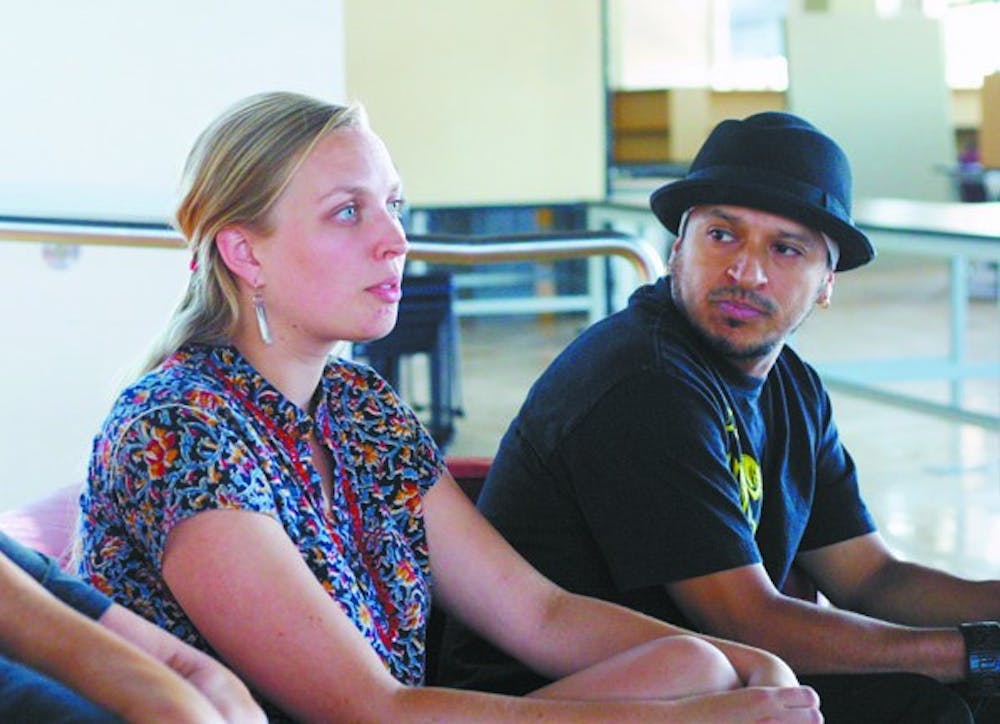

High school students displaced from their home countries have found comfort in a free hip-hop dance class in Phoenix, though the future of the program is now in question.
This past spring, the Herberger Institute’s School of Dance partnered with the International Rescue Committee to present a the dance class to refugee students in central Phoenix high schools.
The class was created to provide students with a free, physical form of expression and a small slice of American culture.
Alexandra Ostasiewicz, early childhood and youth coordinator for the International Rescue Committee, said she isn’t sure how the class will continue because of the unknown budget come fall.
“It’s always uncertain,” Ostasiewicz said. “It’s funding.”
Pegge Vissicaro, director of the Office for Global Dance Research and Creative Partnerships, is working to keep the program going into the next school year. As the students go on summer vacation, Vissicaro and others are attempting to find a way to make the class sustainable for the future.
Vissicaro is attempting to secure funding from the Herberger Institute to pursue the development of the program.
“We want to build on this program, and I think that’s the challenge,” said Vissicaro, who has worked with refugee programs for about 10 years. “How do we continue? We still need funding. We need space. We have to think about, how do we serve these kids?”
The class, available for free to refugee students, was conducted in the Phoenix Urban Research Lab on the Downtown campus, but Vissicaro is not sure whether the program will continue in that space.
Despite the uncertainty of the program’s future, Vissicaro is confident the dance class is just the beginning stage of a more comprehensive program.
“What the School of Dance is interested in is really broadening the perspective about and rethinking what is the role of dance in society,” Vissicaro said. “There are so many other ways dance can engage communities.”
This is one of the main reasons, Vissicaro said, why she’s establishing the refugee hip-hop dance class.
Ostasiewicz said this class is ideal for the International Rescue Committee’s efforts among teenage refugees.
“[It’s] a way to help support refugee high school students who are trying to integrate,” she said. “Becoming a part of your new community; feeling like you’re a part of the culture.”
Vissicaro said she hopes to establish a program where ASU dance students would work with the instructor, Jorge Edson Magana, also known as “Bboy House,” in an apprenticeship program.
Magana, an ASU alumnus, said he enjoys working with the students and hopes to continue teaching the class.
“I want to learn about [the students], because it helps me teach them,” Magana said.
Magana taught students who came from Burma, Thailand, Bhutan and Afghanistan. Although there were cultural differences to overcome in the beginning, like communication, Magana said that by the end of the class the students had changed.
“As much as it was a dance class – that wasn’t the core of it,” Magana said. “The core was … getting them to feel accepted and feel as if they’re a part of the culture.”
Reach the reporter at joseph.schmidt@asu.edu