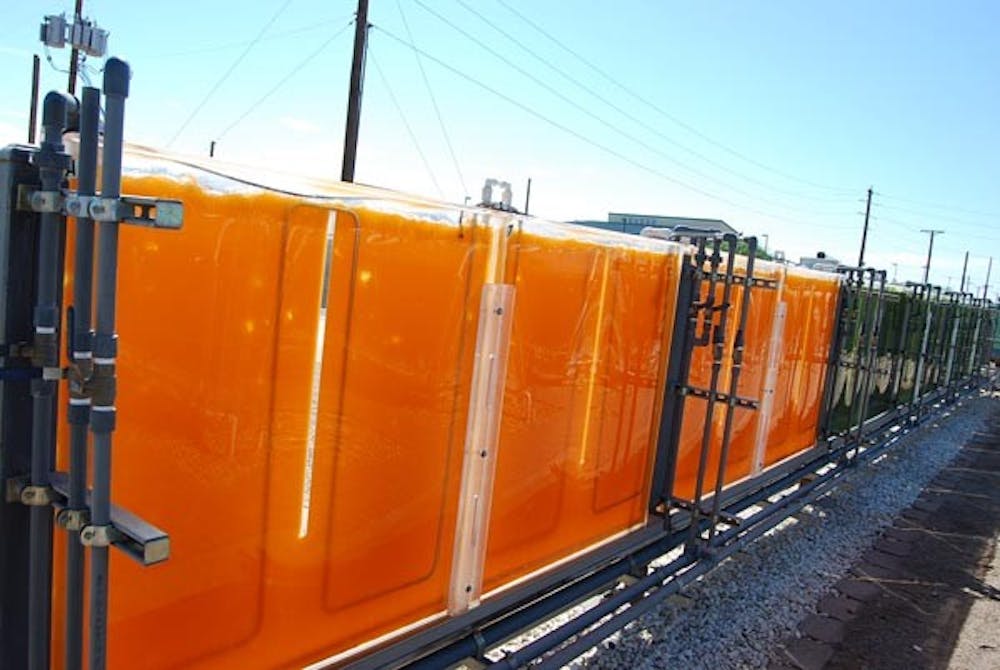

The research of an existing ASU lab that works with algae has piqued the interest of the Arizona governor, prompting the state to fund a new algae research center on the Polytechnic campus.
Gov. Jan Brewer announced Tuesday that ASU will receive a $2 million grant to fund a project called the Arizona Center for Algae Technology and Innovation, known as AzCATI.
The announcement came on the first day of the fourth annual Algae Biomass Summit, hosted by the Algal Biomass Organization, a Minnesota-based organization dedicated to researching ways to turn algae into sustainable commodities such as fuel and food.
The conference was held at the J.W. Marriott Desert Ridge Resort in Phoenix and ended Thursday morning.
The center is a collaborative effort between Science Foundation Arizona, an organization devoted to strategic research in multiple scientific fields, and an ASU lab at the Polytechnic campus dedicated to utilizing algae in research.
The new center will become part of the Laboratory for Algae Research and Biotechnology, said Christine Lambrakis, the Polytechnic marketing and communications director.
In July, the lab received a $6 million grant from the U.S. Department of Energy.
The lab has been utilizing algae in research for decades, and several publications have recently applauded ASU’s work in the field.
Time Magazine named a fuel developed by the lab one of the magazine’s 50 best inventions of 2008, and an Aug. 27 Arizona Republic article tagged the University a factor in the state being at the center of a potential billion-dollar biofuel industry.
Though the program has seen interest increase vastly in recent years, Milton Sommerfeld, co-director of the lab, said they were one of the first programs to focus on algae research. Sommerfeld added that getting in on the ground floor and perseverance in times when interest in algae was not as high, were factors in ASU being seen as a major contributor to the industry.
“We just built on that information that we started in the 1980s,” Sommerfeld said. “We continued, though sometimes slower than we did now, but we’re not new to the field.”
Sommerfeld added that the amount of sun and open space in the Southwest could also be the reason for Arizona’s leading role in algae research, as these conditions are beneficial for photosynthetic organisms that feed off of sunlight.
Mark Luebker, spokesman for ASU’s Office of Knowledge Enterprise Development, said current research at the lab could lead to the creation of a more efficient method of fueling the nation.
“We could replace all of the United States petroleum fuel need with 15,000 square miles of algae bed,” Luebker said, citing an estimate from the University of New Hampshire. “That would only be 13 percent of the total land area of the state of Arizona.”
Luebker added that another reason algae is such an enticing organism to research is because it can grow in a multitude of places. “Algae grow in just about anything,” Luebker said. “It even can grow on animals.”
Sommerfeld said that algae can grow and be grown in vastly different environments because there are innumerable amount of species of organisms that can be called algae.
“Some have said there are 1 million different species of diatoms, which is just one group of algae,” Sommerfeld said.
The number of different algae help explain why the organisms can grow in various environments and behave differently, Sommerfeld said.
He added that because algae can make drinking water less desirable for consumers, they can turn an existing problem for water treatment plants into a sustainable resource.
“Algae and waste water have always come together,” Sommerfeld said. “What we’re doing is taking out those unwanted nutrients and using it to build more biomass.”
Reach the reporter at michael.reppenhagen@asu.edu