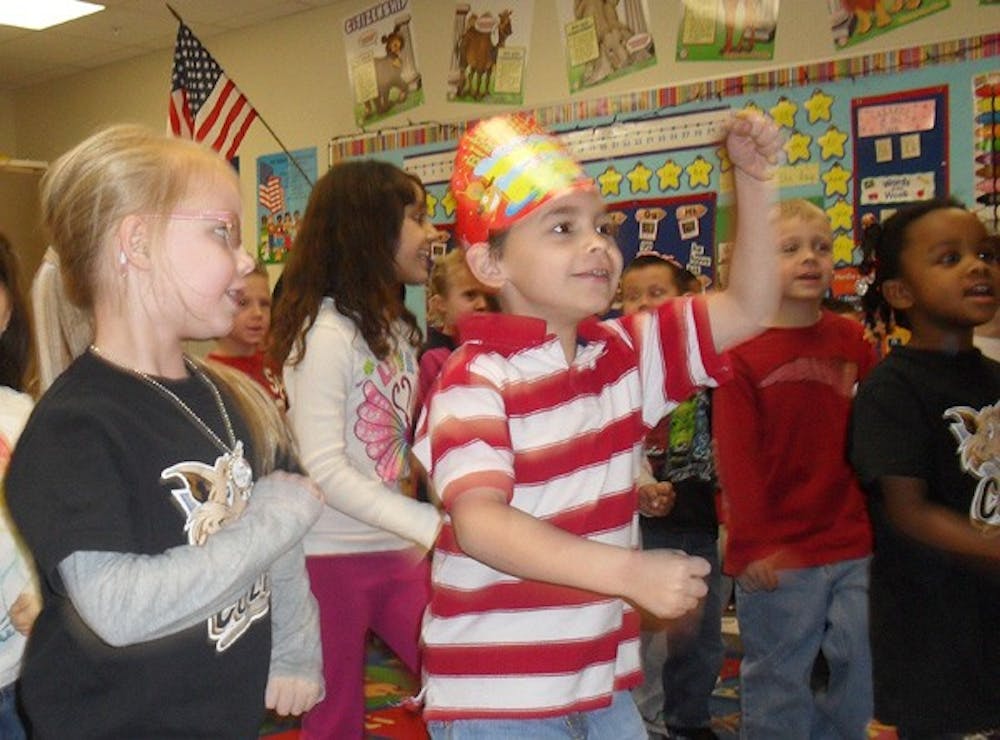

“This is the way we walk like a duck,” kindergartners at Kyrene de la Colina Elementary sang as they waddled across the floor.
The kindergartners imitated their song and dance from a 10-minute video created to teach them about health and fitness. The videos were part of a comprehensive curriculum designed by ASU Professor Emeritus Chuck Corbin, who unveiled his national childhood “Fitness for Life” program last March to prevent obesity in schools.
The curriculum started at the beginning of the school year as a pilot program in Paradise Valley elementary schools and will eventually be implemented at 168 elementary schools in Tucson. It is also being used at Horizon Community Learning Center, a K-12 school on 48th Street and Fryre Road, and at Kyrene de la Colina Elementary in Ahwatukee.
The curriculum, which includes separate 10-minute workout videos and nutrition messages for every grade level, is incorporated for four weeks once a quarter during the pilot program stage, Corbin said.
Corbin said he was pleased with the 100 percent participation he saw in the song and dance exercises at Kyrene de la Colina Elementary School.
“I wanted to see how many kids were singing along, and they all were,” Corbin said.
Last week, students at Kyrene de la Colina Elementary School near 36th Street and Knox Road were in their third week of the program.
Gwen Kaiser, a fourth grade teacher at Colina Elementary, said the program has worked well for her class.
“I always use a lot of music and movement in my class anyway,” she said.
She said the most important part of the program is that it encourages students to talk to each other about fitness.
“I’ve heard them coming back from lunch talking about nutrition,” she said.
Kaiser said she would support integrating the program all year round.
Mary Dean, the physical education teacher and program coordinator at Colina Elementary, said that some teachers use the program for longer than just the four weeks that it has been implemented school-wide.
“Getting the teachers to buy in, that’s one of the challenges,” Dean said. But she said this program has been successful.
Each week focuses on an important part of a healthy lifestyle. The third week focused on how protein builds healthy muscles, and the fourth week will focus on flexibility.
The fourth and final fitness week at Colina Elementary is scheduled during AIMS testing, and Dean plans to offer yoga sessions before school to supplement the program’s message.
As part of the pilot program, Dean is also doing research to see if children talk about health-related topics at home after weeks that emphasize good health.
“We want to know if this is meaningful to them,” Dean said.
Dean is working on the project with Pamela Kulinna, an ASU professor specializing in physical education. The research is going to continue through surveys of children and parents over several years, and Dean hopes the results will be published in a peer-reviewed journal. Corbin is not directly involved in the current research, but he said he does support it.
The message seems to be getting through to some students.
“If you are not healthy, you can get sick and suffer from disease,” said Easton Humphreys, a third-grader at Colina Elementary.
Reach the reporter at mary.shinn@asu.edu