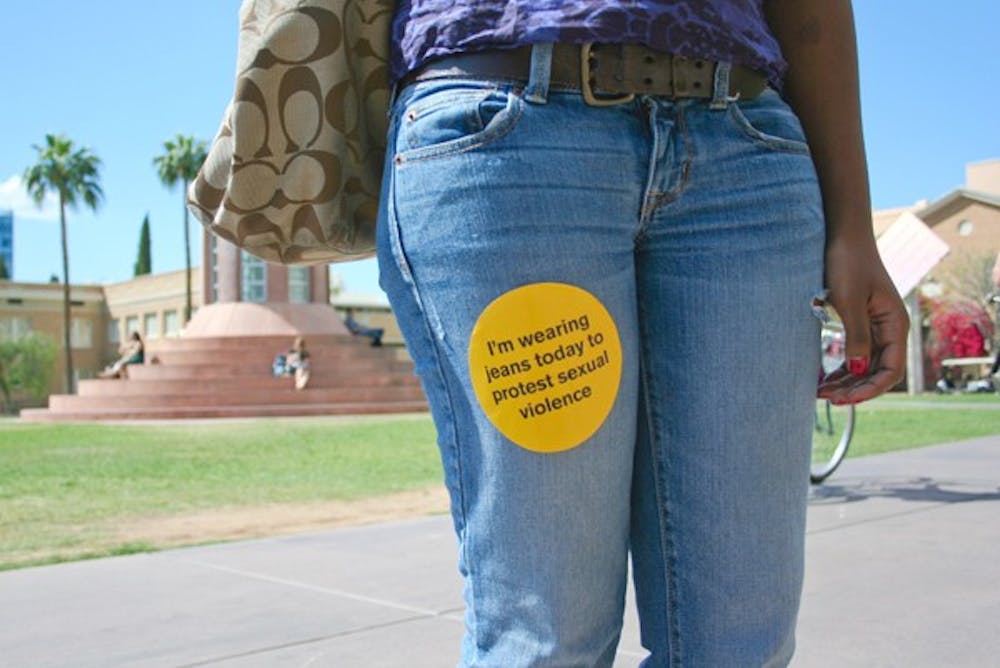

Advocates on all ASU campuses wore jeans to educate the community about sexual assault Thursday.
The ruling on a rape case in Italy led to Denim Day, a national event to raise sexual assault awareness.
In 1992, an 18-year-old woman in Italy was picked up by her driving instructor and taken to a secluded area, where she was removed from the vehicle and violently raped.
Though her instructor threatened to kill her, she reported the rape. The instructor was prosecuted, found guilty and incarcerated.
According to the Columbia European Journal of Law, the defendant appealed the sentence in 1999 and by ruling of an Italian Supreme Court decision, the rape conviction was overturned “because the victim wore very, very tight jeans, she had to help him remove them, and by removing the jeans it was no longer rape but consensual sex.”
Outraged, female members of the Italian legislature protested by wearing jeans immediately following the decision. Since then, wearing jeans on Denim Day has been a symbol of protest against myths about sexual assault.
Though the “jean” decision was eventually overturned in 2008, according to the Columbia Journal of European Law, Denim Day continues to bring awareness to the issue.
“It contributes to overall comprehension about sexual assault prevention,” ASU Wellness Director Karen Moses said.
According to ASU Wellness figures, 3.3 percent of female ASU students and 0.4 percent of male ASU students reported they experienced an attempted or completed sexual assault in the previous year.
The ASU Wellness campaign for sexual assault prevention includes information on how to be a good bystander, risk reduction, sexual health and stress prevention, Moses said.
Denim Day participants ranging from faculty to student employees, volunteers and interns dedicate their time and efforts to the cause.
Criminology graduate student Kelli was raped after leaving a night shift from her former bartending job in October 2006. Because of the delicate nature of the matter, Kelli has asked for her last name to be withheld.
“The guy stayed in the bar with his hands in his pocket the whole time and didn’t buy a single drink … he made me uncomfortable,” Kelli said.
The perpetrator followed her home, forced himself through the front door and then raped her.
After calling the police, Kelli then had to undergo a rape kit test.
“The process of reporting a rape is almost re-victimizing,” she said.
The police did not continue the investigation.
“[My] dress code was provocative and as soon as I mentioned the bar I worked at, they became incredibly dismissive … before that was mentioned they were attentive,” Kelli said.
No formal charges were filed and the perpetrator remains unknown.
“Never think that it couldn’t happen to you,” she said. “It is important to have awareness.”
ASU Wellness can refer sexual assault victims to counseling services and resources such as a sexual assault hotline.
“We provide information and support,” Moses said.
In an effort to help publicize Denim Day, ASU Wellness Health Educator Lynda Seefeldt promoted the event by creating flyers, stickers and distributing print and electronic bulletins.
Students wore yellow stickers that read, “I’m wearing jeans today to protest sexual violence” as part of the campaign effort.
“The stickers were distributed to Wellness coordinators campuswide,” Seefeldt said.
The Denim Day event description was also featured in the University Housing newsletter via email, she said.
Moses recommends visiting the ASU Wellness website to become more involved.
“We’re always looking for student volunteers and employees,” she said.
Reach the reporter at cstarboa@asu.edu