Welcome back, Devils! If you’re anything like me, you’re a little bit sad right now to have to wave goodbye to the summer of a lifetime and go back to sitting in a classroom. But at the very least, we still have the memories, pictures, and crafts to make it last.

This summer, I studied abroad in Peru with Barrett, The Honors College. Along with fifteen other students and two professors, I lived, learned, and became immersed within the Peruvian culture. During our first week, we were stationed in Lima along the coast and spent times in the local parks of the Miraflores District, buying Peruvian-made art, and reading the works of Mario Vargas Llosa. The rest of our time was spent in Cusco, with an exception of a trip through the Scared Valley on our way to Aguas Calientes and Machu Picchu.
Although the trip was just three weeks, I really felt a strong connection to Peru and the country’s history. Personally, I think the one component that made this so for me was the art and Peruvian handiwork that was available on what seemed like every park or street corner. The most ubiquitous handmade items sold by street vendors and stores alike were textiles made from alpaca fleece. Crafters would weave together beautiful tapestries, sweaters, socks, scarves, bracelets, belts, hats, ponchos, table runners, blankets, bags, and basically anything else you could possibly think of to sell. As students with a limited amount of money, we mainly came in contact with indigenous people striving to make a living by selling their crafted work.
Art and textiles especially have been a part of the indigenous Peruvian culture for centuries, dating back to even pre-Incan times. Their textiles were used as offerings to the gods and gifts for visitors, as well as an important aspect of war and the home. Textiles were such an important part of the natives’ lives that if they were about to lose a battle to an enemy, they would rather burn the storehouses of their beautifully woven textiles, just so their enemy could never get their hands on them. We read about this story for class one day and it blew my mind how much art could mean to culture.
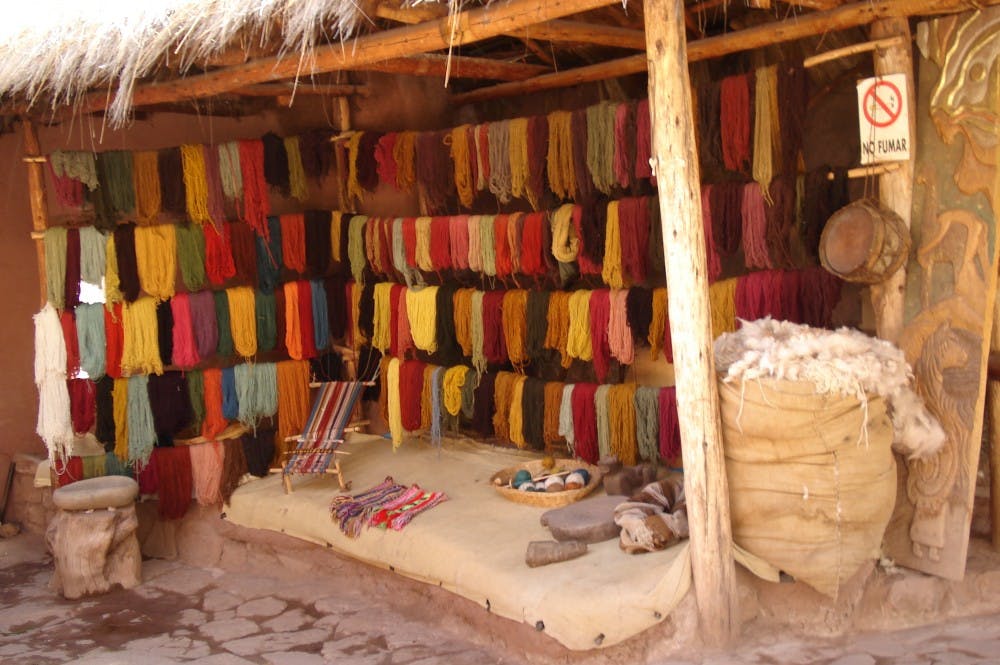
In terms of alpaca fleece, baby alpaca is the softest while adult alpaca, though soft, can get to be a bit itchy. Either way though, the material is very good quality and is easily dyed. I bought my mom plain white baby alpaca yarn to knit with, but I also saw magnificently dyed yarns dyed by using various plants and other organic materials. For myself, I bought an alpaca sweater along with various bracelets and hats, while others on the trip went a little alpaca-crazy and bought nearly everything in sight.
Besides textiles, many artists sold their paintings or photos (especially of the infamous Machu Picchu), as well as shoes, chocolate, leather-made goods, pipes, bags, and other items.
For anyone interested in textiles, knitting, or art in general, Peru is probably one of the best places to travel abroad to in order to fuel your crafty desires.