
Phoenix’s pedestrian-challenging sidewalks and streets brought students and community developers, among others, together Thursday at the Walk the Walk, Talk the Talk event near the Downtown campus to explore how foot traffic can be encouraged in the area.
Professors, city officials and architects attended the lecture and “walking audit” event, hosted by ASU’s Phoenix Urban Research Laboratory, an extension of the Herberger Institute for Design and the Arts, and Discovery Triangle, a public-private nonprofit group that promotes development in the Valley.
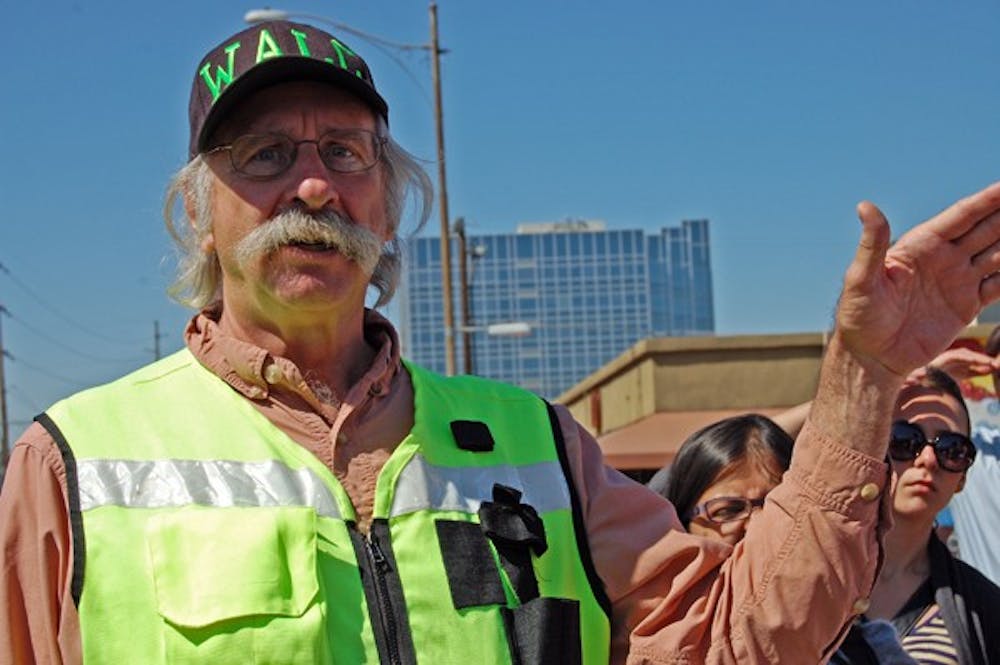
Dan Burden, executive director of the Walkable and Livable Communities Institute, an organization promoting neighborhood involvement, said Phoenix’s light rail system is a small part of what the city needs to get people walking.
“Phoenix, unfortunately, has made some huge mistakes with its transit system and made folks here so car-dependent that they now have a long way to solve those issues,” Burden said.
Burden, recognized in 2001 by Time magazine as one of the six most important civic innovators, discussed these mistakes with attendees on an “audit walk,” where the community was invited to walk the neighborhood and voice opinions for improving downtown Phoenix streets.
Burden said he has worked with engineers who had never walked the cities they were developing.
“How can you design for the needs of people if you don’t try to make it across the intersections on your own?” Burden asked the dozens of attendees. “Once we did that, we not only got better designs, but then we said we can apply this to entire corridors, to entire neighborhoods, to entire cities.”
As participants walked through downtown Phoenix, they noted that the intersection at Roosevelt Street and Central Avenue had a lack of shade and a fast flow of traffic.
While crossing the crosswalk near the light rail, attendees said they did not have enough time to safely cross. Burden agreed.
“(Designers) were so concerned with the extra seven or eight seconds it would take for the cars to wait that right at the light at a transit system, (they were) not allocating enough time,” Burden said.
Landscape architecture junior Brett Berger said the event came at the perfect time. He and his classmates must model a community in downtown Gilbert for a class project, incorporating all forms of alternative transportation.
“It’s a good way to bring a focus to my project and to enhance it,” Berger said. “What we’re trying to create is a livable community where people want to hang out.”
Sean Sweat, a downtown Phoenix community organizer and activist, said he was excited to see so many officials from the city participate in the audit walk.
“The most important issue for Phoenix right now is having a place that people want to live in, and walkability is the key to that,” Sweat said. “It ties into sustainability and everything.”
Reach the reporter at kmmandev@asu.edu
Follow us on Twitter or like us on Facebook. Click here to subscribe to the daily State Press email newsletter.