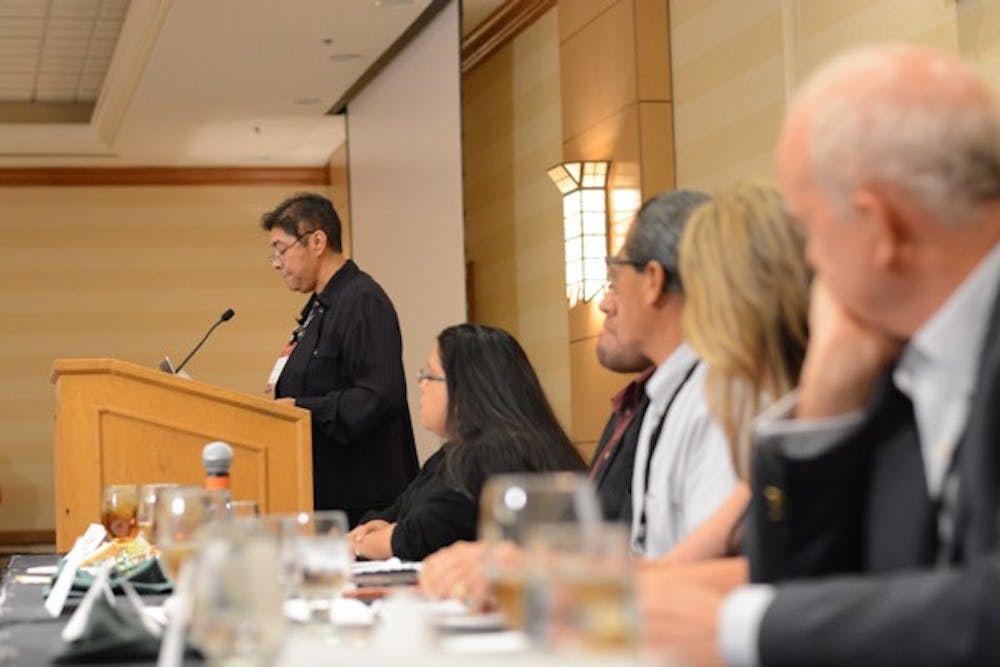
 Psychology professor Delia Saenz introduces the panel of speakers at the Indigenous Sustainability Conference on Tuesday, Oct. 7. The event featured multiple speakers from the University. (Photo by Jonathan Williams)
ASU students and staff gathered at the Tempe Mission Palms Hotel on Mill Avenue and Fifth Street for the first two-day Indigenous Sustainability Conference about different sustainability issues.
Gary Dirks, director of the Julie Ann Wrigley Global Institute of Sustainability, headlined the group and was one of the speakers on the panel that discussed many different sustainability issues.
The keynote presentation was made up of a panel of University professors and one from New Zealand.
“Sustainability is not environmentalism wrapped up in a new way of language,” Dirk said. “Sustainability is the totality of us and the environment in which we live in.”
The event was hosted by the President’s Office of American Indian Initiatives and featured different panels of University officials. On the first day, the conference opened with an invocation and University President Michael Crow followed with a presentation to members of the audience.
Accounting freshman Dristan Bahe helped coordinate the conference and also volunteered there. Bahe said he felt the event was a success.
“The speakers are saying so much,” he said. “There's so many different points of view. It’s very cool and engaging.”
Bahe said he was interested to hear what the students thought of the event as well. He said it was worth all the time and hopes the event will continue annually.
On day two, another blessing came before a welcome from University Provost Robert Page and another series of panels and presentations.
American Indian Studies senior Monique Reveles attended the conference.
“I think it (the conference) definitely started that conversation that we always needed to have to get the School of Sustainability to focus more on American Indian nations,” Reveles said. “In the School of Sustainability, it’s all about indigenous people around the world, when there are indigenous people here.”
Urban and environmental planning graduate student Alesha Sloan came to the event with Reveles. Sloan said she could only attend the second day of the event and enjoyed a few of the speakers.
“I feel like many people don’t really understand sustainability, especially in the context of how I learned it and how I see it.” Sloan said.
W.P. Carey School of Business Professor Mark Stapp was the final speaker at the event. He said he had been impressed with the event and is willing to write a letter to administration to make the conference an annual event.
“We need to do something else, because we can’t let it die,” Stapp said.
Reach the reporter at jwilli62@asu.edu or follow him on Twitter @JonWilliams_23
Like The State Press on Facebook and follow @statepress on Twitter