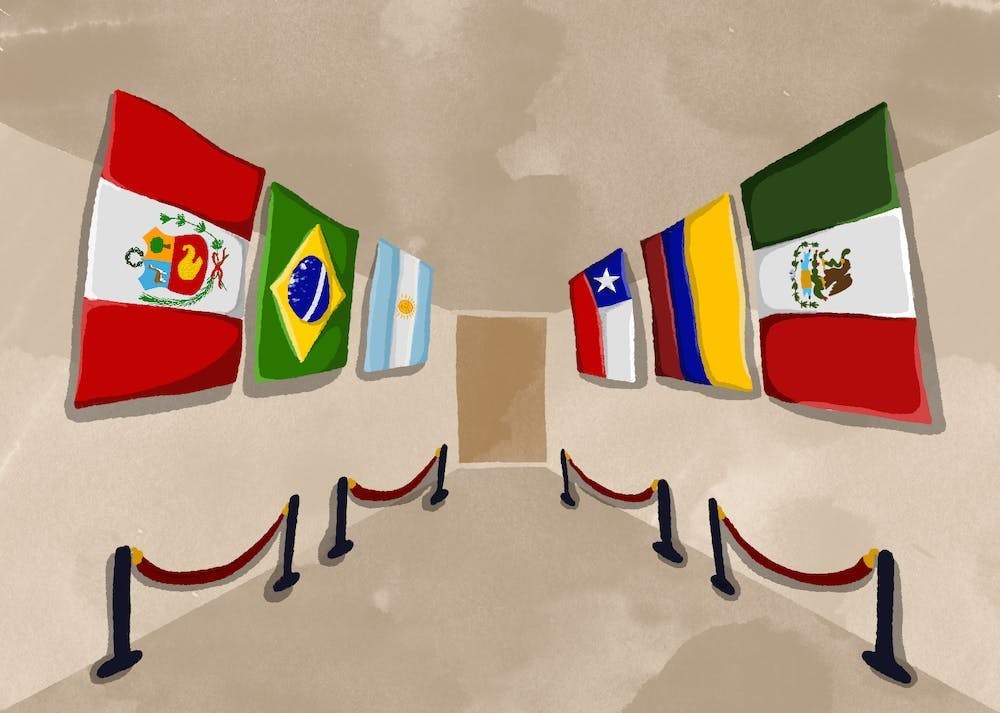
When I first decided to enroll at ASU, I felt this massive evergrowing pit in my stomach filled with the fear of not fitting in.
I'm a first generation Mexican American who grew up speaking Spanish and English. I went to a public high school that had a failing academic reputation, but I grew up around people like me — something I was scared of not having in college.
When I opened the email from ASU confirming my acceptance, I was terrified. I knew that choosing a white, male dominated field like journalism would mean constantly feeling out of place.
How will I fit in? What am I losing out on by going to this university? Why do I feel so lost in this process?
READ MORE: Successes and setbacks of being a first-generation student
I also knew I did not have the kind of money to pay for a dorm out of pocket, which meant I'd either be working or at school on a daily basis, not leaving much time for a social life.
This is a feeling many first generation, especially Latino, students face when attempting something no one else in their family has done. But that familiar fear is what keeps us going.
After all, my parents faced much harder struggles to get me to where I am now. The lessons, stories and culture they instilled in me is something I carry close to my heart when life feels like too much, as it is for many other Latino students.
"Ponte las pilas"
Alondra Aceves Lopez, a sophomore studying biomedical sciences, grew up in a Hispanic household. It had its fair share of dichos, which have also played a large role in her life. She recalls this phrase, which directly translates to put on the batteries, frequently.
But for Hispanic people, this phrase means to get up and work, essentially saying: Put in your batteries and do whatever it is you need to do.
"Si vas hacer algo, hazlo bien"
This is a phrase both Aceves Lopez and I grew up hearing one too many times. Its meaning is clear and to the point — if you are going to do something, do it right.
"El burro trabaja doble"
A lot of wisdom that has been passed down to Latino generations is based in the idea of hard and honest work. This is another popular saying that mothers tell their children to ensure they are behaving properly.
These words directly translate to the idiot works double or the donkey works double. The message of the phrase is to say: Do something right in the first place, or you will have to go back and redo it.
"Ríete de la vida, o la vida se va rier de ti"
This saying has stuck with Aceves Lopez and is one her father passed down to her. The expression translates to laugh at life or life will laugh at you.
To her, the words her father spoke were meant as an encouragement to keep going even when things were not heading in the direction she wanted.
"I like to keep it in the back of my mind," she said. "Things are tough right now, but we just have to see the positives ... you can't really live a life with so much negativity."
On days when I'm not feeling motivated to do school work or even show up to my job, the sayings my mom ingrained in me at a young age push me toward success.
While these words may seem simple, they bring a sense of familiarity. These lifelong words of wisdom are not just from family at home but from ancestors and their past communities.
"When I tell students knowing that you come from a community of knowledge systems, a community of power (and) a community of traditions of history, it provides this idea of resilience," said Rafael Martinez, a professor for Southwest Borderlands in the College of Integrative Sciences and Arts.
"Sana, sana, colita de rana"
Other wisdoms that may not be as deep but still provide some comfort include this one, which means heal, heal, little frogs tail.
If I'm being honest, these words do not really make sense, but I am confident that a majority of Hispanic people grew up hearing this anytime they were injured or not feeling well.
This is simply a chant that is recited to those in pain in an attempt to get their mind off it — which is why it is usually used with children.
Martine Garcia, an assistant director of strategic initiatives for ASU Career Services who grew up Chicano, recalls hearing these words from his grandmother.
"Automatically, I felt better, right? Like, not only my ailments, but my physical, my spiritual ailments. I just felt loved in those moments." Garcia said.
It's a different experience, something many other people might not relate to. Latino families and traditions have always prided themselves in that familial knowledge and comfort.
READ MORE: 'They come back dancing, they come back singing'
La Llorona
This experience is also seen in my culture's folklore, for instance, with this popular legend. While the story has differing origins depending on the region, the basis of this story is the same; a weeping woman who haunts and kidnaps children who she mistakes for her own dead children.
"(It's) a folklore tale that warns children, and it serves as a way to say 'when the lights go down, you go home and you stay with family,'" Martinez said.
These are the stories and sayings Latinos and Hispanics, like me, have grown up with. To this day, I get nervous walking down a dark street because of the dangers installed in me as a kid. At first La Llorona, and now any psycho who would wish me harm.
These dichos are what make us Latinos the way we are. We unapologetically love our families and our silly sayings. We are taught to be wary of the dangers in the world, and most importantly, we are told to succeed in every facet of life.
Edited by Natalia Rodriguez, Senna James and Pippa Fung.
Reach the reporter at dbtorre4@asu.edu.
Like The State Press on Facebook and follow @statepress on X.
Daniela Torres Martinez is a part-time community reporter for the State Press. She has previously worked with the Chic Magazine at the Walter Cronkite School. She is in her first semester with The State Press.