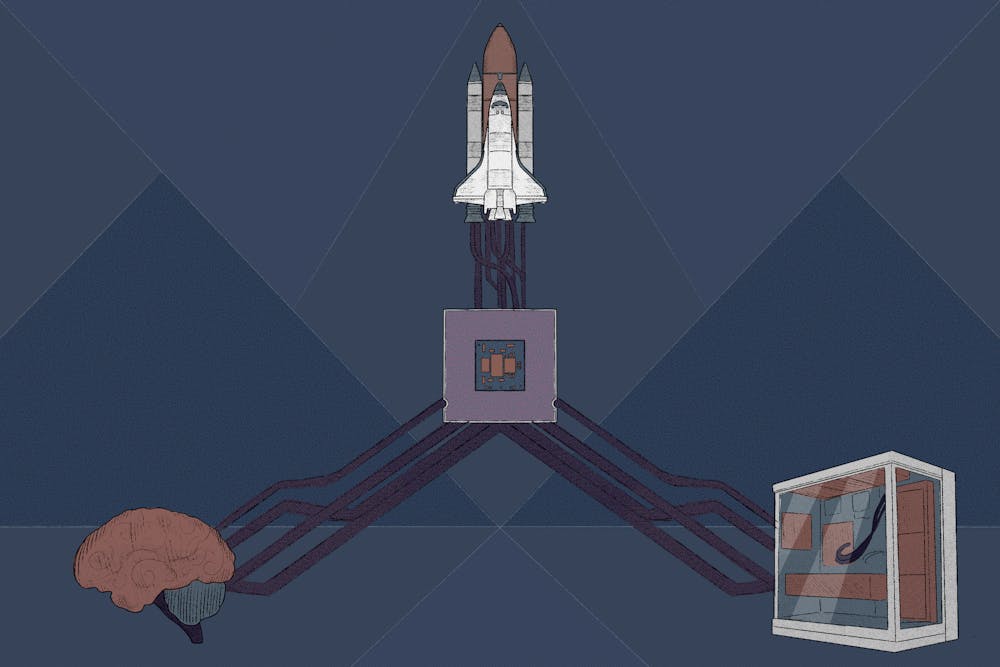
The Semiconductor Device Research Laboratory (SDRL) is working on manufacturing semiconductors in space and using memory technology based on the mechanisms of the brain.
The SDRL is researching how to implement novel resistive random access memory (RRAM) technologies in emerging AI and machine learning contexts, and then taking such innovations and providing a feasible method for fabrication and use in space exploration.
"We not only work on just the device fabrication side, but we also work on the characterization as well," Sai Prakash Maddineni, a graduate student studying electrical engineering and research assistant in the SDRL, said. "We fabricate the device, both on the land and in space, and we test them."
LISTEN MORE: Deep Dive: Semiconductors
RRAM is a class of emerging computer storage that retains data even when powered off. The technology being developed at the SDRL has the benefit of less energy consumption than typical storage devices and is about 10 times smaller than other memory devices.
The hardware is a new type of non-volatile memory being developed to replace conventional flash memory technologies, which have lower durability. It's much cheaper and simpler to manufacture, and the lab is researching how to fabricate it in space, Yujian Huang, an SDRL research assistant and graduate student studying electrical engineering, said.
The lab is working on implementing a form of printing-based fabrication in microgravity and space environments, which Huang said improves the device manufacturing process. The lab is focused on novel printing-based fabrication, as it is more flexible than traditional fabrication processes, less expensive and does not require a clean room.
"It demonstrates that the potential of in-space manufacturing is doable; it's not something in a dream," Huang said.
The SDRL is not only exploring in-space fabrication of semiconductor devices, but is also working to understand how the similarities between the human synapse and RRAM technologies can be implemented into neuromorphic computing.
Neuromorphic computing is inspired by the functions of the human brain. Specifically, it investigates how the synapses of the brain communicate. Researchers use the concept of synaptic weight to describe the strength of the connections between neurons, which is similar to the electrical properties of the RRAM technology.
The electrical properties of the RRAM device can be engineered to imitate changes in synaptic strength that occur in the brain, said Jordan Dunn, a researcher in the SDRL and a senior studying electrical engineering.
"We're basically trying to mimic brain function with it and then use that in AI computing," Dunn said.
READ MORE: ASU's semiconductor community faces uncertainty after funding cuts
The parallel between semiconductor memory technology and biological synapses can be more efficient than traditional methods, Maddineni said. He added that the lab's work can lead to creating a "new type of emerging memory" that is more energy efficient.
The SDRL researchers are hopeful for the possible uses of RRAM technology and its potential environmental benefits. Maddineni said the devices could benefit the computing industry by driving more efficient water and resource use.
"If we can create a better memory device with the new techniques by reducing (resource consumption), it would be good," he said. "We can implement it both on the land as well as in space itself."
Edited by Kate Gore, Senna James and Ellis Preston.
Reach the reporter at jdtamay1@asu.edu follow @JTamayo46036 on X.
Like The State Press on Facebook and follow @statepress on X.
John Tamayo is a science and technology reporter in his first semester with The State Press. He is a senior majoring in Physics and Philosophy.