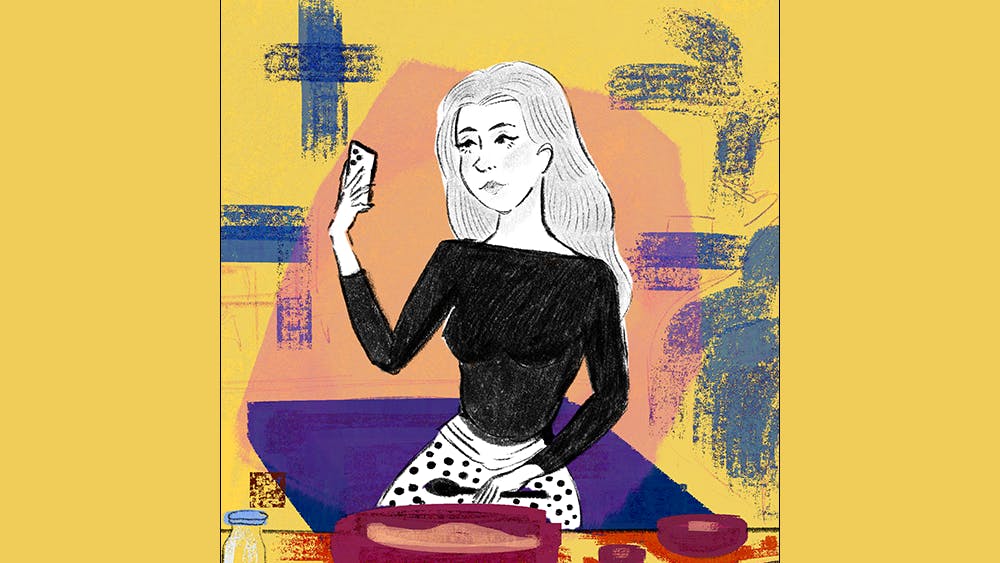
She is a full-time homemaker. With the ability to bake a fresh loaf of sourdough from scratch, a baby in arm, she effortlessly balances the abundance of duties that come with raising her many children, keeping the house in order and tending to the needs of her bread-winning husband.
She is the picture of femininity: young, God-fearing, conservative in both thought and dress — and is incredibly proud of her European heritage.
This is the "traditional" wife, an identity that has recently reemerged in online popular culture. Social media platforms are flooded with content and imagery of these women, and as you scroll through media under this tag, you might notice some defining features.
In terms of setting, these women are, of course, in the house. They may be cooking or cleaning something and they are most likely surrounded by children. If you look closer, you'll find they are almost always wearing a tea-length dress, sometimes an apron over top. Their hair is blonde and they wear minimal makeup, if any at all. The most consistent similarity of this bunch, however, is an overwhelmingly white demographic.
Trad wives online
Traditional culture or "trad" culture refers to the ongoing popular movement surrounding women who embrace traditional gender roles. Online, trad influencers have taken to social media platforms to promote their lifestyles through delicately curated displays of what it takes to manage a home: caring for children, cleaning and cooking.
Autumn Gulley, a sophomore studying biomedical engineering, expressed her thoughts on the reemergence of this content. "It's just kind of strange to see it resurfacing again (and how) these women (are) falling back into these stereotypical roles."
This trend pulls from mid-20th- century nostalgia and conservative idealism, highlighting traditional family values. While having made a significant impact on platforms like TikTok in recent years, earlier origins of the trend can be traced back to lifestyle content on YouTube in the mid-to-late 2010s.
"Wife With a Purpose," or Ayla Stewart, is a blogger and YouTuber who began promoting tradwife content in 2017. Stewart began her blog in an attempt to "support the revolution of radical traditionalism," producing posts urging readers to follow this lifestyle. Stewart quickly began promoting white-nationalist rhetoric on her platform, with one example being her commencement of the "White Baby Challenge."
In 2017, Stewart posted to X stating, "As a mother of 6, I challenge families to have as many white babies as I have contributed. We can win the Utah racial war and protect its unique LDS European Heritage."
This challenge was created as a remedy to the white nationalist "great replacement" conspiracy theory, which suggests the deliberate "replacement" and "repression" of white populations by minority groups.
Stewart's attempt to mobilize her followers in this way further highlights the dangerous rhetoric that lies within this trend and how easily this culture can be weaponized.
One of the current influencers at the forefront of online tradwife culture is Hannah Neeleman, known online as "Ballerina Farm." Neeleman is a social media figure who produces content that centers around her life raising eight children and selling products from her family's farm.
In the beginning of her influencing career, Neeleman posted content about becoming a farmer and the adjustments that came with it. Over time, she began sharing more pieces of her personal life and clued viewers into the inner workings of her home and family.
Audiences grew intrigued with the visuals of Neeleman's life as a homesteader. Her most popular videos on TikTok depict her preparing various meals from scratch while her children chatter in the background. Neeleman herself doesn't speak to her audience in most of the clips; instead, they are treated as a brief window into her everyday life. Currently, her TikTok page has 10.6 million followers.
Behind Neeleman in most videos is an opulent green cast-iron stove that, at one point, was cause for discourse among people online. This 1991 AGA stove, which retails today in similar models for almost $40,000, was a major point of dispute. Viewers began to question the attainability of the lifestyle being marketed in Neeleman's content.
Audiences have since discovered that her husband, Daniel Neeleman, comes from an extremely wealthy family as his father is the founder of JetBlue and several other airlines. This launched a discussion surrounding Neeleman's lack of transparency in how her family is able to support their "traditional" lifestyle while she makes content for her large audience.
Atia Muzaluba, a freshman studying finance, commented on the feasibility of being a tradwife, saying that it is not possible for many "since a lot of women are working or they just don't have the finances to sustain that lifestyle."
Influencer and model Nara Smith has faced similar scrutiny in regards to her own content, which has also become associated with trad culture.
You might've seen Smith's viral TikTok videos or even parodies online, where she creates intricate dishes from scratch while dressed in extravagant outfits, speaking in a breathy whisper. Smith began creating this content around late 2023 and quickly gained virality for the unique nature of her videos.
"While my toddlers were playing in the backyard, they asked me for a Capri-Sun. Since I had all the fruit at home to make some, I told them to give me a minute while I got started," Smith said in a TikTok from 2024.
While most of her content consists of cooking videos, Smith also shares details from her home and family life, raising four children as a young mother and the dynamics of her marriage with fellow model Lucky Blue.
Smith has been at the center of a few controversies in recent years, having to do with her family's affiliation with The Church of Jesus Christ of Latter-day Saints, her promotion of traditional culture and allegations of content plagiarism.
Last year, Smith was accused by South African creator Onezwa Mbola of copying and profiting off her content, which centered around cooking from scratch and the intricate processes behind it.
These allegations launched a conversation about the implications of colorism in Smith's rise to popularity. Many viewers asserted that Smith's position as a light-skinned, mixed-race woman coupled with the traditional rhetoric behind her videos, aided in making her content more palatable for white audiences.
Soft life, hard truth
"Soft life" trends originated from Nigerian influencers post-pandemic. These creators took to social media, sharing the necessity of centering rest and mental health during stress- inducing times.
Initially, the soft life movement acted as a form of respite for Black women seeking to detach from pressures associated with hustle culture and "strong Black woman" stereotypes.
Much of the content under #Softlife consists of TikToks urging viewers to embrace minimalism, self-care routines and more practices that strive to reflect a low-effort and relaxation-centered lifestyle. An unintended result of this trend, however, was a growing desire in audiences to maintain a perceived idea of femininity that is often unafforded to women of color.
"I want to appear more feminine," a TikTok user commented under a video captioned "I love being a soft, feminine, black woman." While the soft life trend aimed to push back against harmful tropes used toward Black women, it eventually opened the door for damaging ideas surrounding femininity within the community — centering passiveness, 'delicacy' and other traditionally conservative ideas.
Addressing the dissonance
There are quite a few parallels between soft life and trad wife trends, namely in their approaches to feminine ideals and glamorization of domestic labor. As these two movements began intersecting in terms of visual aesthetics, the contrast in their ideological roots became glaring.
Trad culture was born from reminiscence to a period when women were discouraged from entering the workforce and encouraged to be homemakers first. This, however, was not the case for women of color.
Throughout American history, women of color have always had to work. In the mid-20th century, this labor was mostly secluded to domestic service, aiding in the homemaking efforts of white upper-middle class "housewives."
The current resurgence of this identity promotes a culture that women of color have historically never been involved with — so is the "tradwife" label only truly applicable to white women, or is it possible for these spaces to be reclaimed? And if so, should they be?
In an article for Grown Magazine, writer Kamaria Jade stated, "We're being told that the way to be valued is to be smaller, quieter, more traditional, more conservative. To shrink ourselves into a version of femininity that was never designed with us in mind and has historically been used to oppress us."
Jade's statement highlights the ideological incongruencies in how women of color have interacted with traditional culture through trends like "soft life," illustrating the involvement of Eurocentric beauty standards in what is considered "feminine," according to this trend.
"Social media and what we see (on it) is a reflection of our society, and the trend of (trad wives) reflects more stereotypical roles of women in kitchens. And I feel it's kind of a step backwards," Kaitlyn Daniels, a sophomore studying biological sciences, said.
A general concern around the growing popularity of traditional ideas, is the impact it could have on feminism and gender equality today, especially as younger generations on platforms like TikTok, consume this content.
According to Katie Economopoulos, a freshman studying aerospace engineering, trad culture could have potential "detrimental effects" on the progression of modern feminism, as it idealizes a lifestyle that once represented the oppression of women.
Lola Del Pizzo, a freshman studying political science, shared similar thoughts: "When we see people dressed up in the sort of outfits that they're wearing, and the sort of voices that they’re using and the way that they're editing, it feels like it's romanticizing something that (does) not necessarily (need) to be romanticized."
Many of the dangers of trad culture arise in the promotion of a potentially harmful lifestyle, without full transparency on the realities of what it takes to maintain it. And for women of color, this risk lies further in entering a space that, at its core, advocates for their oppression.
Edited by Leah Mesquita, Natalia Jarrett and Abigail Wilt. This story is part of The Purity Issue, which was released on December 3, 2025. See the entire publication here.
Reach the reporter at kwalls6@asu.edu
Like State Press Magazine on Facebook, follow @statepressmag on X and Instagram and read our releases on Issuu.
Keyanee Walls is a magazine reporter at The State Press. She is a second year student at ASU’s Walter Cronkite School.