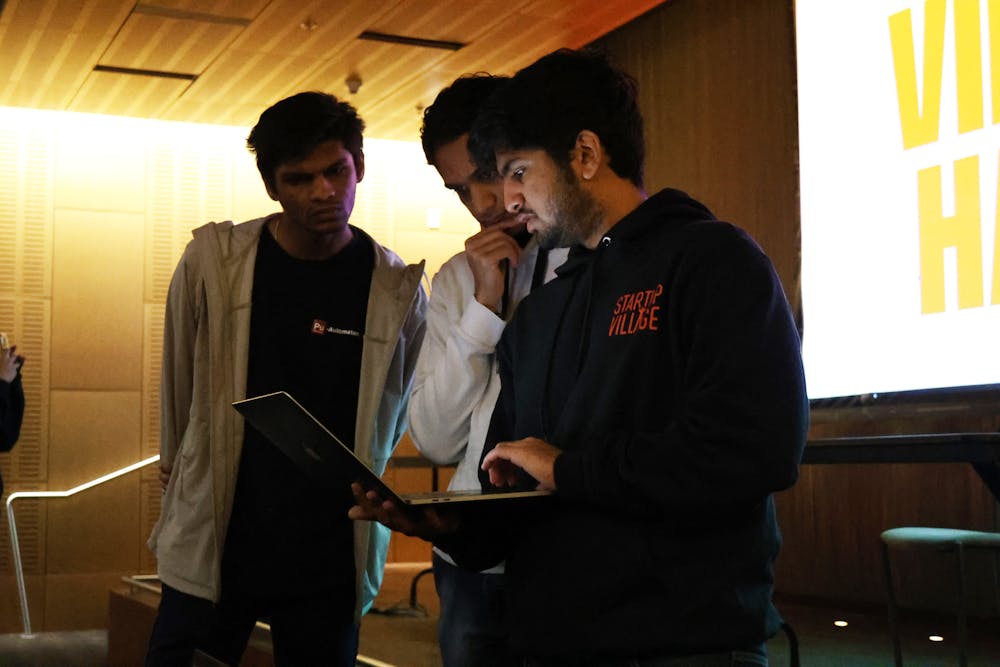
Recently, hackathons have become a common sight at ASU. From large flagship events to small club-specific gatherings, the format keeps ASU students coming back for more.
University colleges and student tech clubs host coding competitions and build-a-thons throughout the academic year. To organizers, hackathons can provide a clear framework and avenue to connect with young developers, and to students, the events promise practical experience and collaboration at a rapid pace.
Cecilia La Place, an ASU alumna and the founder of sunhacks, said for some, the events' appeal lies in students' ability to "supplement" their learning outside of traditional classrooms. She added that students can feel like their classroom learning doesn't necessarily reflect the same industry relevance as a hackathon learning environment.
"For some, hackathons are an escape from the classroom that's usually for students who find that the classroom is not serving them as well as it could," La Place said.
She described hackathons as structured, time-limited spaces designed to encourage cooperation and problem-solving. The time limit for a hackathon is typically 24 to 36 hours, which La Place said "forces collaboration in a positive way."
READ MORE: One of the biggest hackathons in Arizona returns for its eighth run
For event organizers, hackathons also serve to build community. Dhanush Vardhan, president and co-founder of Devlabs and a junior studying computer science, said a hackathon the club put on in September helped the organization grow to more than 500 "builders."
"The word kind of spread out there (at DevHacks), saying Devlabs is uplifting the startup community here," Vardhan said. "That's all we want, and I think we got that."
Vardhan emphasized that DevHacks was organized as a hackathon to introduce students to entrepreneurship. The event brought venture capitalists and startup founders on as judges for the competition.
Manav, a graduate student studying computer science, said DevHacks was the first hackathon he attended. The positive experience Manav had at the event motivated him to participate in sunhacks later that month, which he described as a "huge exposure to the technology."
Manav said the decision to attend often comes down to opportunity rather than comparison. He added that even when a project does not place well, hackathons can still be worthwhile because they result in tangible work and connections that can carry forward beyond the weekend.
"If we get a good project, we can continue (in the) future," Manav said. "We can get key connections, which may be helpful, and also exposure."
READ MORE: Sun Devils tackle real-world problems at DevHacks2025
The difference in hackathons, according to La Place, is the organizer. Events partnered with Major League Hacking tend to follow similar structures, while others are tailored to specific communities or disciplines.
La Place had a research interest in hackathons for her Ph.D. in engineering education systems, which she completed in 2025. According to her research, students' gains from hackathons largely depend on their goals.
"A hackathon does not develop good coding skills," she said. "People might learn how to throw together a solution in 24 to 36 hours, but they may not do it in a way that is scalable or robust or sustainable."
However, La Place said hackathons often help students learn how to find information quickly and problem-solve under pressure. She emphasized that the hackathons can encourage students to find new ways of processing information and inspire them to "deep dive" into the material.
"There are many avenues to leverage hackathons in unique ways, even if the novelty of having a hackathon is wearing off," La Place said.
Edited by Kate Gore, Jack McCarthy and Pippa Fung.
Reach the reporter at ngmohta@asu.edu.
Like The State Press on Facebook and follow @statepress on X.
Nikhil Mohta is a sophomore studying B.S. in Finance and is currently a Business Community Leader for the W.P. Carey School of business. He is also an active member in various clubs on campus like PIERA.