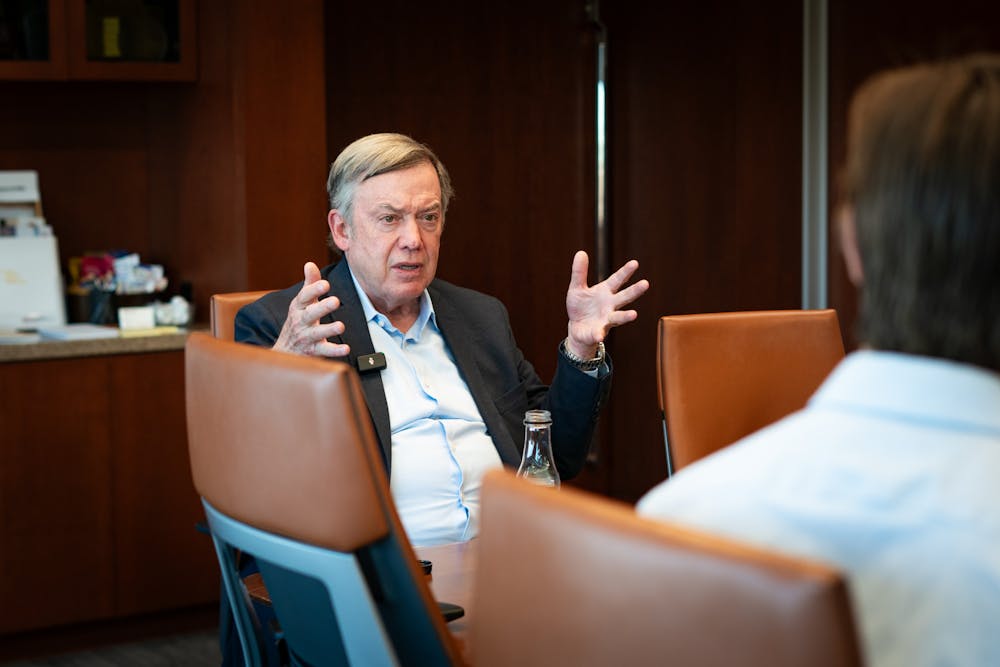
At the Arizona Board of Regents' University Governance and Operations Committee meeting on Thursday, President Michael Crow and the presidents of NAU and UA each presented their 2026-27 school year budget proposals.
ASU's budget proposal encapsulates academic fee proposals not previously approved by the board, new program and college fees, changes to existing fees and increases to tuition and fees greater than the maximum tuition range set by the board, according to the committee book for the meeting.
Crow said this long-standing 15-year process has evolved the tuition and fee proposal process for ASU. Step-by-step, he said, they created "a modest tuition and fee, high financial aid model."
"We promised in that step of our process to make certain that affordability and access to the institution would achieve record levels," Crow added.
Next, is moving the University toward an environment where it can keep "tuition and fee increases low and modest, while at the same time maintaining affordability and access," he said.
To achieve the University's overarching goal to demonstrate leadership through accessible academic excellence, Crow specified the subset goal to "maintain the fundamental principle of accessibility for all students qualified to study at a research university."
He prefaced ASU's mantra that anyone who applies and is qualified is admitted. Since ASU has such a large student population, Crow said it is the University's role to increase accessibility to the institution and take steps in providing pathways to an education.
"Affordability is not just, can you afford to go to the school," Crow said. "(It's also,) can you get out of the school? Can you actually graduate?"
The budget proposal will help the University achieve its goal, Crow said.
The proposal is for 25 new graduate program fees and two increases to graduate program fees. Also included is a new annual undergraduate and graduate provost advanced technology fee of $200, which, according to the committee book for the meeting, is "to provide students access to artificial intelligence tools and platforms and other technologies."
The 25 new graduate fees span across nine colleges, including the new John Shufeldt School of Medicine & Medical Engineering, and the Rob Walton College of Global Futures, which, in September, received the largest gift donation to ASU — a $115 million philanthropic investment to establish the Rob Walton School of Conservation Futures.
READ MORE: Donation of $115 million will found new School for Conservation Futures
The new graduate fees are expected to add an estimated $36,344,900, and the advanced technology fee another estimated $28,106,400.
Executive Vice President and University Provost Nancy Gonzales said, at the meeting, that since a lot of the fees are directed toward the new colleges or health-related efforts, they are well justified.
Crow said they believe the fees will help bump up the graduate rate and freshman retention while enhancing efficiency.
"We really appreciate your focus on affordability and ensuring that Arizona students have all of the opportunities that ASU affords them," Jessica Pacheco, regent and chair of the University Governance and Operations Committee, said following Crow's presentation.
A public hearing for the proposals will be held on April 8 to allow for public comment on the fee proposals. In a public notice, ABOR provides a link to register to speak at the virtual meeting, including instructions on how to participate in testimonies.
"The Arizona Board of Regents' budget process, including opportunities for public comment, is an important way to ensure transparency and gather input as we plan for the university’s future and continue advancing our mission of access and excellence," a University spokesperson said in a statement.
Edited by Senna James, Jack McCarthy and Ellis Preston.
Reach the reporter at elbradfo@asu.edu and follow @emmalbradford__ on X.
Like The State Press on Facebook and follow @statepress on X.
Emma Bradford is a senior reporter at The State Press and in her senior year, studying both journalism and political science with minors in business and Spanish. She has previously interned with AZ Big Media and NEWSWELL Chicago, and completed her capstone at the Cronkite News D.C. bureau; she is currently interning with KJZZ. This is Bradford's sixth semester with The State Press; she was a part-time politics reporter for three of those semesters and a full-time politics reporter for one.