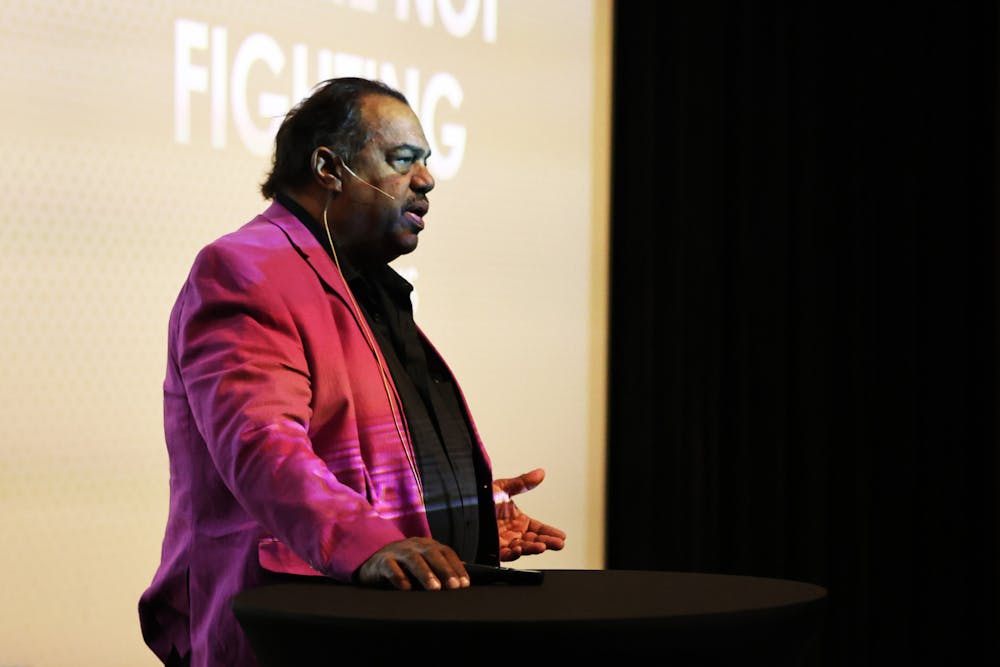
Daryl Davis, a Black musician who dedicated his life to changing the beliefs of white supremacists, spoke, sang and played piano at "Klan We Talk?" on March 19.
Hosted by ASU's Lincoln Center for Applied Ethics, Davis challenged attendees to have conversations with those who disagree with them through empathy instead of aggression.
During the lecture, Davis told several stories about his conversations with white supremacists and Ku Klux Klan members. He emphasized that mutual respect and connection are key ideas when facing ideological differences.
"Everybody wants to be loved," Davis said. "Everybody wants to be respected. We all want to be heard."
READ MORE: Amid political turmoil, one ASU professor is urging engagement in civic conversations
Davis grew up traveling around the world for his parents' work, and said he first encountered racism at 10 years old. From that experience, he formed the question: "How can you hate me when you don't even know me?"
That question led him to seek out people with racist beliefs and bring them into conversation. A notable instance was his work with Virginia KKK leader Richard Preston.
According to Reuters, in 2017, Preston attended a "Unite the Right" white nationalist rally in Charlottesville, Virginia, and fired a gun at a man from close range. He pleaded guilty to shooting a firearm within 1,000 feet of a school and was sentenced to eight years in prison, four of which were suspended.
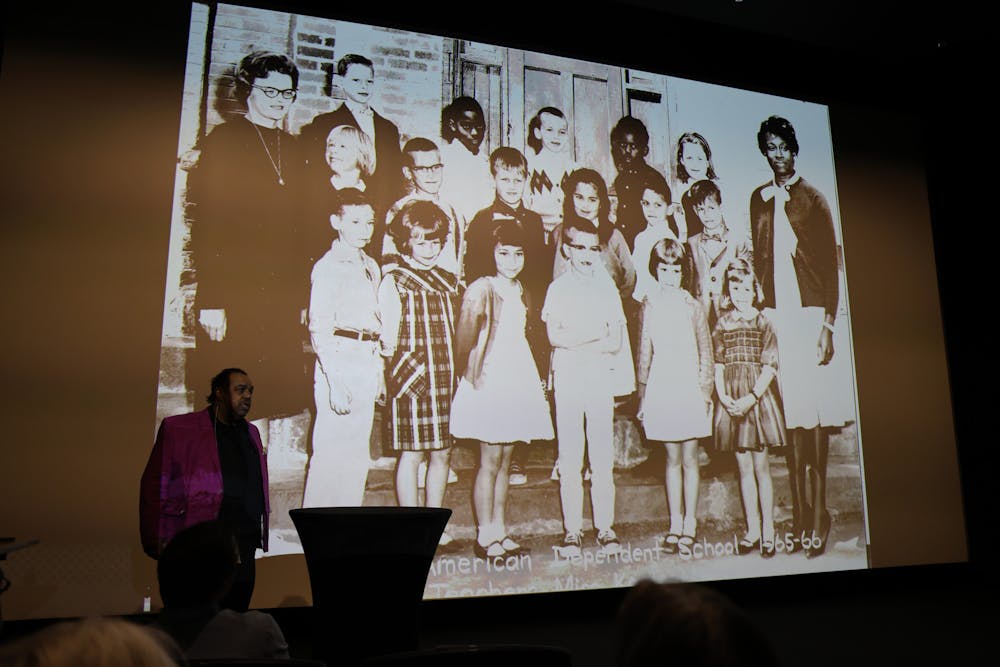
Carlyssa Hordge, an attendee of the event and a junior studying general studies, was struck by the "risk" Davis took in having such conversations.
"(Davis is) coming unarmed, ready to talk," Hordge said. "He could have easily been killed a multiple amount of times, putting his life on the line."
Davis said after he saw the video of Preston, he asked to meet in person. Davis went to Preston's home, which he said had walls full of KKK paraphernalia and a couch covered with a Confederate battle flag blanket.
He then listened to Preston and his fiancée's perspectives without interrupting.
"It's when the conversation ceases that the ground becomes fertile for violence," Davis said.
Davis took the pair to the Smithsonian's National Museum of African American History & Culture on a later date, where he and the leader bonded over their love of music.
Davis worked as American guitarist and singer Chuck Berry's piano player for 32 years, and while at the museum, the group went to view Berry's Cadillac on display. Together, they posed for a photo in front of the car.
Davis emphasized music's role as a connecting force, pointing to Berry's widespread popularity among artists and listeners alike from all backgrounds.
"White kids and Black kids could not help themselves," Davis said. "This new beat just made them want to get up and dance ... they were dancing and boogying in the aisles together for the first time in the history of this country."
In addition to speaking, Davis also performed multiple songs on the piano, including "Johnny B. Goode" by Berry.
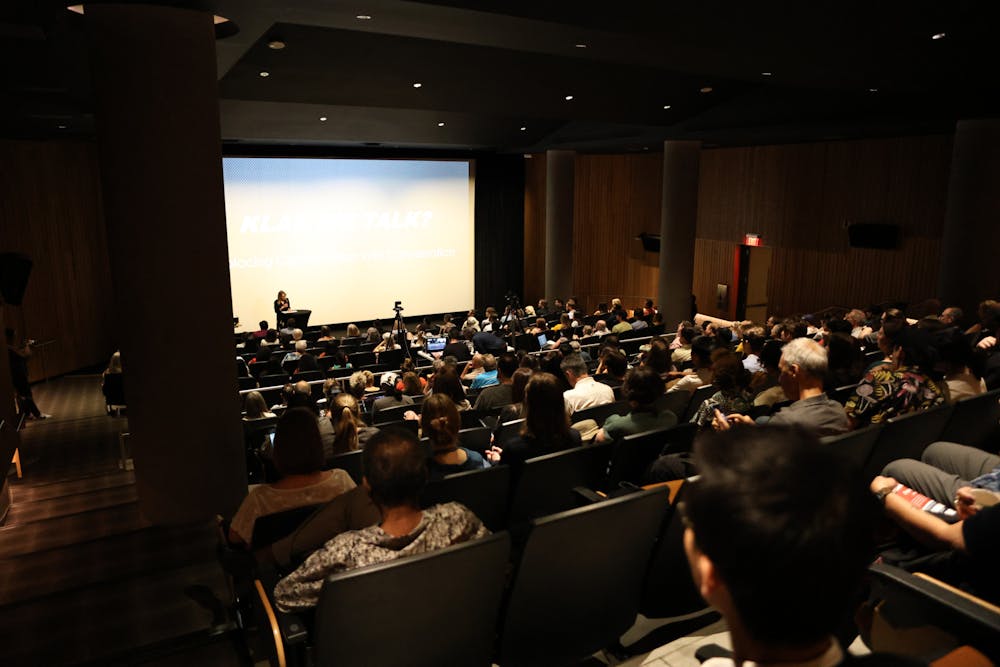
Elizabeth Grumbach, assistant director of research and strategic communications at the Lincoln Center for Applied Ethics, said the music played following Davis' speech brought event attendees together in a special way.
"What we know from folks like Daryl Davis, but also the historical civil rights movements, is that it's joy, it's music, it's dreams, it's sermons, all those things are the things that really bring us together," Grumach said.
Grumbach said speakers like Davis demonstrate that listening is just as important as other types of political activism, including civil disobedience.
"We need to start with care, start with listening to each other, and then from there, we'll know where to point the compass," Grumbach said.
Edited by Kate Gore, Senna James, Emilio Alvarado, Sophia Braccio and Pippa Fung.
Reach the reporter at omoranwi@asu.edu.
Like The State Press on Facebook and follow @statepress on X.