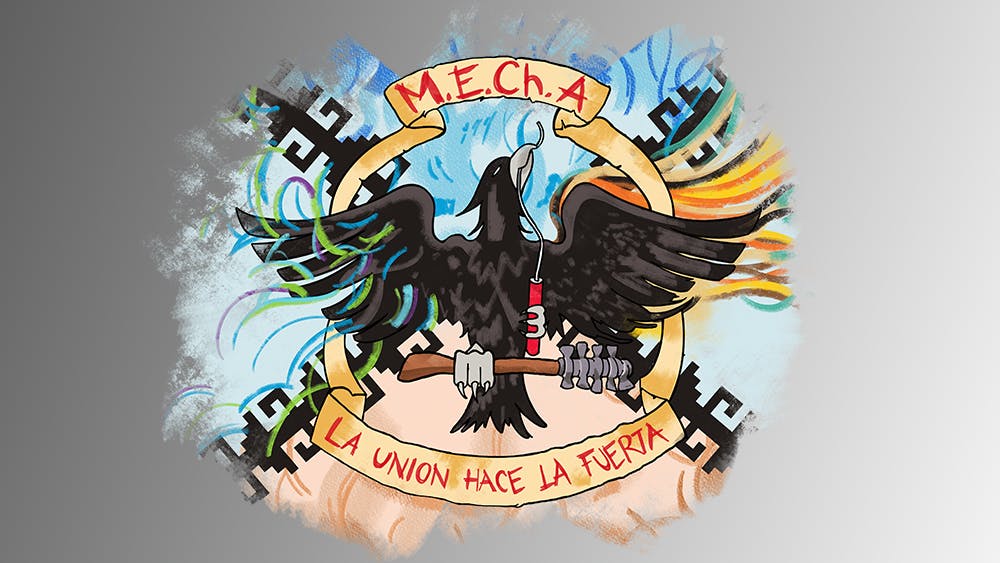
The MECHA room, located in the basement of the Memorial Union, has been locked for over a year.
The quiet, mural-adorned space gained notoriety among many on campus for its rare comfortability and distinctive artwork honoring Chicano history. Several organizations used the room, and many individuals saw it as a unique and multicultural safe space for all students.
Nico Altamira was a Mechista (or member of MECHA) for two years. "Towards the end of September (2024), somebody had just kind of one day found it locked," she said. "There was no notice that the room would be locked."
According to Altamira, MU employees didn't even realize what had happened until they answered requests to unlock the door, only to find the key no longer worked. She also said that MU employees hadn't been told the room was locked.
Shortly afterward, ASU hung a piece of paper outside the MECHA room with a QR code leading to an online form to fill out, which was supposed to help get back any personal items left in the room, according to Altamira.
"To our knowledge, anybody we'd been in contact with who has filled out that form and tried to get stuff out of the room … there's been no response," she said. "When ASU finally communicated with one of our partner groups, they were told that that form is really just for people if their phone or laptop was in the room."
Though the room's closure was a decision the ASU administration first made in the aftermath of Chicano advocacy organization MECHA de ASU's ban from campus, some are now calling for the space to make a return amid increasing immigration raids.
The room
In February 2024, MECHA de ASU was temporarily suspended as an organization after posting two videos of police body camera footage with a caption saying "Death to the boer. Death to the Pilgrim. Death to the zionist. Death to the settler." ASU ruled that the post's language qualified as a death threat.
In September of the same year, MECHA's suspension was changed to indefinite and ASU locked the room shortly thereafter.
However, MECHA was not the only group that used the room. Organizations like Zen Devils — a club teaching Zen Buddhism — the Sudanese American Association and briefly Students for Socialism also occupied the space.
Individual students used it as well. "A lot of people gravitated to the room," Altamira said. "I think it was comfortable for a lot of people who would not necessarily have been comfortable everywhere else on campus."
"There are a lot of students who want to be involved in spaces but are aware that in those spaces they may meet homophobia, they may meet racism, et cetera," said Mia Bazbaz, a graduate student studying justice studies and a former Mechista. "In the MECHA room, that wasn't the case … From the second you stepped in the door, it was about safety, it was about norms we agreed on."
"It's a relaxing place where people do a little homework or take a call," Altamira said. "There's always a group of people who are just casually talking and having a good time … There are custodians who take their breaks in the room."
Part of the MECHA room's appeal was its atmosphere. Bazbaz said the room was filled with murals, protest signs and other artwork depicting Latin American resistance as well as a mini-library, comfortable sofas with blankets and often free food.
"It's a totally unique room, totally different vibe than anywhere on campus," Altamira said.
"Everything that was there was not ASU stuff," Bazbaz said. "It was student art, student-provided furniture, students cleaning the space, students keeping their stuff there."
The space also had several beautiful Chicano altars that Altamira didn't want to leave behind.
"There are altars in the room that are culturally significant, that should be protected, should be tended to," she said. "If they're just gathering dust in a dark room, that doesn't feel right."
Struggling for existence
According to Altamira, ASU administration argued in a meeting with activists that they locked the MECHA room to protect the property inside. But with no way for people or organizations to retrieve most of their belongings, those items were irrecoverable.
"If that were the case, there would definitely be a better way to go about that," Altamira said on the University's logic.
The University told organizers the room will not be unlocked until MECHA is reinstated. With MECHA still in limbo ever since its ban, and many of its leaders having graduated and wanting no involvement in negotiations with ASU, this is a lofty goal.
"Even if (MECHA) doesn't get reinstated, that room has other uses and that room is important to other people," Altamira said.
Bazbaz highlighted the room as a place where students experiencing food insecurity could find something to eat and a place where students could rest safely and comfortably. "It was financial support, it was rest, it was safety," they said. "It was a lot of things, so a lot of students really feel the loss of the room, even if they weren't in MECHA."
This is not the first time organizers at ASU have had to fight for the MECHA room's existence. After the original room burned down in a fire at the MU in 2007, it took years for the University to establish a new one.
"There has always been a fight for the room," Altamira said. "It's always had to be a struggle, and so it'll have to be again."
Present challenges
Immigration and Customs Enforcement was set to recruit students at the Sandra Day O'Connor School of Law on Jan. 22, which led to opposition led by the Chicano/Latino Law Student Association. ICE backed out of the event, but no further information was provided as to why they canceled.
"For our community, ICE is not just an employer," a statement put out by the organization said. "It represents family separation, detention, and fear. Allowing ICE to recruit students in a space that should be reserved for collaboration and learning sends a message that these harms are disconnected from the lived realities of our students."
Four days later, ICE agents contributed to the searches of 15 Zipps Sports Grill locations across the Valley, arresting 39 people. Zipps restaurants close to both the Tempe and Downtown Phoenix campuses experienced searches.
Maya Dominguez is a graduate student studying law and is the vice president of external affairs for the CLLSA. "That's about a seven-minute drive from Downtown campus," she said of the raid at a Zipps near Central Ave and Thomas Road. "I know that brought up a lot of anxiety for a lot of students, especially the Latino community on campus and other POC communities as well. It flagged for us that ICE is here, they are close by."
Bazbaz said the MECHA room returning could also help increase safety by providing a safe space, claiming many students don't feel protected by ASU. "The combination of the things (ASU) admin has done in the past few years, the kind of speech that flourishes under Trump and the crackdowns that they've implemented at other institutions really points to the need for a space where students are in charge and can establish their presence, their voice, their conversation, their history," they said.
However, it took years of lobbying on behalf of student activists for the University to agree to create the Multicultural Communities of Excellence, ASU's lone, school-sanctioned safe spaces on each of its four campuses. The University has also overlooked requests for an LGBTQ+ resource center on campus for two decades, drawing ire from much of the school's queer community.
"ASU is supposed to be a place that measures itself not by whom it excludes, but by whom it includes — which means students, whatever their status might be," Dominguez said, referencing the University's charter. "The administration can do more and should be speaking up louder to protect all students, but especially those students who might not have a status here in this country."
Editor’s note: Evan Silverberg attended several MECHA meetings from September 2023 to February 2024. He was not a reporter at The State Press during this time.
Edited by Leah Mesquita, Natalia Jarrett and Abigail Wilt. This story is part of The Love Issue, which was released on February 25, 2026. See the entire publication here.
Reach the reporter at evansilverbergrep@gmail.com and follow @evansilverbergwrites on Instagram.
Like State Press Magazine on Facebook, follow @statepressmag on X and Instagram and read our releases on Issuu.
Evan Silverberg is a reporter for the State Press Magazine. Specializing in coverage of social Justice issues, he has published several deep-dives into hard-hitting topics affecting the ASU community. He is in his third semester with the State Press and has been recognized by the Society of Professional Journalists with a Region 11 Mark of Excellence Award nomination.