Click Click. Dominoes sprawl across the wooden table. My feet dangle off the ground, and I carefully trace my fingers along a deep crack in the table’s surface. My sister places her chubby hands on the table, hoisting herself up with her face tied in an angry little knot. Paco is cheating again. Against a 7-year-old.
This is how nights in Puerto Rico usually go — loud and chaotic, with the consistent squeak of the coqui floating through the air. As the night winds down, my grandparents’ house feels ominous and quiet, as if waiting to erupt into its natural state. My feet cling to the tile floors as I roam the house, and the coquis’ gentle chirps swallow the sound of my footsteps. My sister and I’s room lacks air conditioning, and I can never sleep when it’s so hot. The sheets tangle between my legs like an angry snake, so I often abandon sleep to sneak into the kitchen to steal a moment.
The mornings are often quieter; everyone expended their arguing energy the night before. Paco is all dressed up to go nowhere, with a perfectly ironed black suit and glistening loafers. His cologne is strong, almost overbearing. He smells like citrus and sandalwood.
Growing up, his family lived on a plot of land owned by someone else. He had 12 siblings, so his parents eventually sent him to work for a family that could afford to care for him. He grew up with very little. My mom used to say he dressed carefully because it made him feel valuable — like he was worth something.
His favorite spot was a dirt parking lot next to a golf course. He didn't play golf. He would just sit in the car alone for hours and stare. I imagined the dust rising and settling around their old grey Civic as he sat. I always wondered what he was looking at. Lela argued that we should spread his ashes there because it was “his favorite place.”
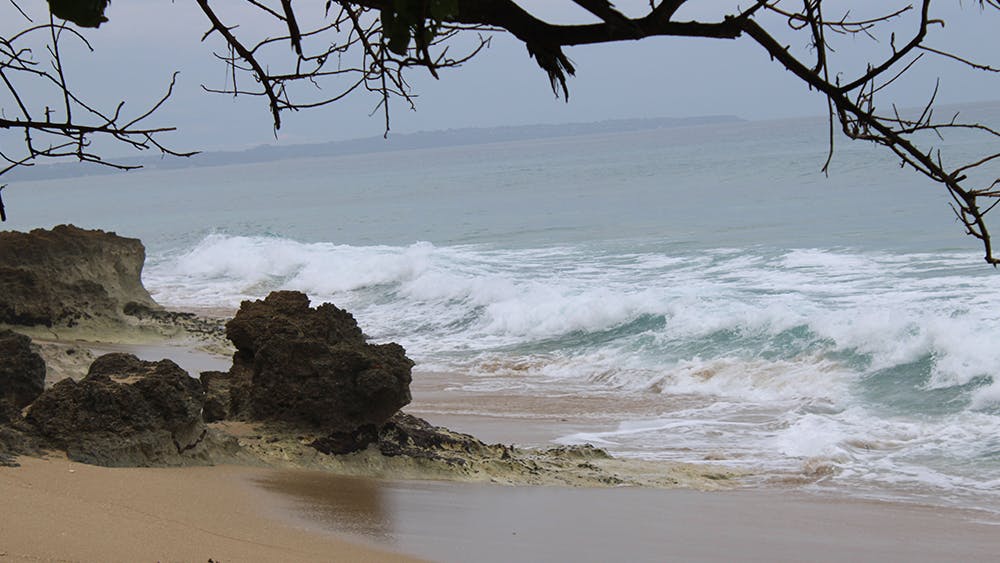
So, we gathered around the golf course. On one side is arguably the least beautiful location in Puerto Rico, looking out on a dirt field and an airport. The other is a view of the coastline. The wind is hot and unforgiving, assaulting my eyes with fine dust. My mom sighs, and her bushy eyebrows fold into each other.
Lela opens the urn, her little paper hands trembling with exasperation. She flings the ashes from the urn clumsily, and the wind swiftly lifts them. The ashes come blowing back at us, pale fragments of bone landing at our feet. I snort, stifling a laugh. Lela’s cries intensify, and an unassuming golfer shoots us a glare.
Grandma Ada cried like a baby when Paco died, but I’m not sure why. Now, she often rambles that he visits her in her dreams, promising to meet her in heaven. In private, I joke to my sister that hell seems more likely.
Their marriage was short and tumultuous. I’ve never witnessed them together, but apart, my blood grandparents reminded me of a burning flame. Together, I imagine Grandma Ada like a yellow gallon of gasoline, dripping along the flame until Paco grew contorted with hot rage.
Both of them valued their pride and would go to great lengths to avoid feeling small — a trait I often recognize in myself. The story is malleable depending on who’s telling it, but it’s clear to me that Grandma Ada wasn’t the type to ever let a man win.
Paco moved on to marry Lela, an Argentinian woman who radiates joy. She could never have kids of her own, so she treated my mother like her own.
They met while Lela was working at an Argentine restaurant she used to own. Paco and Grandma Ada frequented the restaurant during their marriage — a detail that Ada presses into my ear, her broken Jersey accent animated with old gossip.
Now, Lela lives without Paco, and she shows me countless movies of love. She giggles at the TV when the boy gets the girl, and the lines of a full life light up her smile. She wears coral lipstick, and her lips cling together as she chatters, promising me she will get a boyfriend who’s 50 — the perfect age.
Lela cries every time we leave the island, blubbering about how each time we see her will be the last. It makes me nervous, and my insides twist into an uncomfortable knot. We only visit once or twice a year, but these memories provide an anchor I often return to.
Before we leave, my mother wants to visit family at the cemetery. I feel pretty stupid. We’re pacing through a maze of graves placed in a seemingly random configuration, like strewn dominoes mid-collapse. We’re searching for the names of my mother's grandparents — Ada forgot where they were buried. The graves sit above ground, so families can stack on top of each other and pay less for a plot. It’s a tradition born out of necessity, but the idea of bodies hovering beside me makes me squirm.
After about an hour, we find the graves — they are placed in a different, more organized cemetery. The remnants of an angel lie scattered on the graves’ stone surface. My mom looks like she’s going to be sick. They haven’t been visited in a long time.
My dad uses water and a crowbar to soften the flower holders, as the soil has solidified. After much trouble, we place the flowers in their holders. They’re plastic, which means they'll last longer, and their blue hue stands out in a field of gray. I linger at the grave for a moment, frozen. For once, my family has nothing to say.
Carmelo died three months after I was born, and my mother’s eyes glisten as she tells me just how excited he was to meet me. She used to spend summers in Puerto Rico with her cousins, and he would often slice a piece of sugar cane straight from the stalk for her — a delicious gift.
As we leave the cemetery, I don’t feel the wet heat anymore. Although I am only a visitor here, my family grounds me. In their stubbornness, intensity and refusal to go quietly, I recognize Puerto Rico — and myself.
Edited by Leah Mesquita, Natalia Jarrett and Abigail Wilt. This story is part of The Culture Issue, which was released on March 25, 2026. See the entire publication here.
Reach Lucia Zettler at llzettle@asu.edu and follow her on Instagram at @luciazettler.
Like State Press Magazine on Facebook, follow @statepressmag on X and Instagram and read our releases on Issuu.
Lucia Zettler is a Magazine Managing Editor for The State Press. She is a junior studying Business (Law) and Journalism at ASU. This is her second year working at The State Press, with her previously holding the position of part-time magazine reporter.