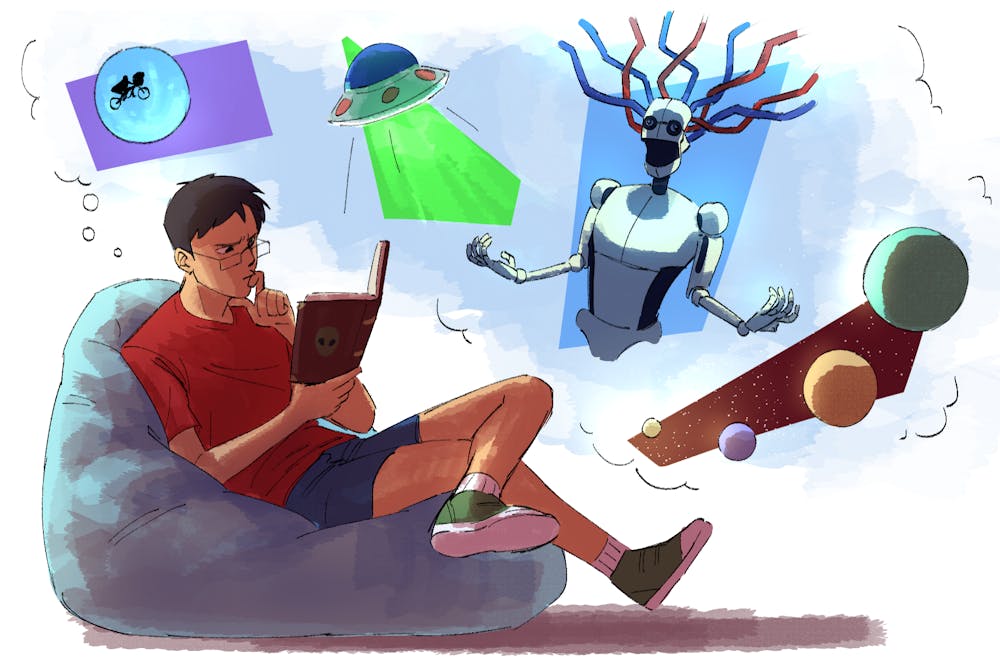
Socrates, Plato and Aristotle, you've done great, but it's time to move over. The grand secrets to life's mysteries have been discovered, and if you buy this book for a one-time payment of $24.99 ($29.99 on hardcover), you'll have the answers to all your woes.
The self-help book market has exploded in popularity over recent years, especially among Gen Zers. Given the grindset mentality's surge in the 2020s, the push to optimize oneself by getting acquainted with "The 7 Habits of Highly Effective People," by Stephen R. Covey, for example, was an expected development.
But in the name of self-help's optimization-centric approach, it's clear to see young adults (and readers as a whole) are barking up the wrong literary tree. In a world all-too-full of real problems, possible cures can be better found and understood by turning to fictional environments.
Unfortunately, fiction's been on a downturn. According to a 2022 study by the National Endowment for the Arts, roughly one in four men read fiction, compared to less than half of women — a decreasing measure over the years.
READ MORE: The Echo's top spring break reads
Despite its waning popularity, fiction has benefits in spades. For starters, fiction differs from other literary genres in its unparalleled ability to stimulate empathy. Stories are naturally more expressive than a cut-and-dry how-to list, meaning narratives tend to be more memorable, digestible and poignant.
Immersing the reader into an outside perspective does wonders for their understanding of the "other" — they see the context, motivation and all the little nuances that go into both how and why people of differing worldviews interact with the society around them.
By engaging with varying perspectives, the reader is able to take away newfound lessons from these characters' unique struggles. For those on a self-improvement journey, learning by example is a proven means of critically (and positively) reshaping one's personal framework.
Especially in today's individualism-dominated culture, works of fiction offer readers a much-needed opportunity to improve themselves and others around them.
"The Great Gatsby," by F. Scott Fitzgerald, teaches Advanced Placement classes across the United States about the dangers of hyperfixating on the past. "Normal People," by Sally Rooney, shows how devastating a lack of communication can be (a must-read for anyone stuck in a soul-crushing situationship). "The Handmaid's Tale," by Margaret Atwood, and its warnings of infringements on bodily autonomy remain a cornerstone of women's rights protests to this day.
By contrast, some popular self-help books, such as "The 48 Laws of Power," by Robert Greene, fundamentally place the reader above the "other." The reader is taught to treat the outsider as competition or as a means to an end for some myopic version of success.
There's no shame in self-development and personal growth, and certainly not all works in the self-help genre follow this modus operandi. Nevertheless, the rhetoric proffered by some of these books that we have to sacrifice human connection in order to succeed strips us of our souls, all for the sacrosanct pursuit of "the grind."
The real beauty of fiction lies not in its figurative prose or its unmatched emotional influence. Rather, the magic and strength of the genre is truly seen when it comes up short. Its restraint, its inaction — the poetic refusal to tell the reader what to think — challenges them to explore outcomes of their own accord.
Less is, at times, more.
Unlike self-help, fiction doesn't sell happiness at the end of the book. If the reader so chooses, they're able to think deeper to come to their own conclusions. There is no spoon-feeding of answers, as fiction inherently incentivises the reader to learn and sharpen their critical thinking.
Fiction's open-ended nature makes narratives such as George Orwell's "1984" leagues more compelling, if not more haunting, than an ordinary political science lecture.
Orwell declines to offer explicit, personal statements denouncing authoritarianism, forcing the reader to carefully observe his constructed, constrictive, subjugative surveillance state, thus compelling them to make their own moral judgment.
With the current political sphere being wracked with the onset of fascism amid the constant torrent of misinformation, critical thought is, well, critical. Capacities such as arriving at one's own conclusions, voicing educated opinions and carrying a degree of intellectual independence are necessities for a healthy democracy to flourish.
As many find themselves relying on prepackaged media narratives, and as many more relentlessly plug simple questions into ChatGPT, it's blatantly obvious that the pursuit of knowledge has been sacrificed in the name of convenience, and the consequences are stark.
READ MORE: Opinion: Keep AI out of my classrooms
Exploring information and finding answers have never been more pertinent, and fiction gears interested parties toward those two end goals to a T.
Self-improvement is a noble goal, one that certainly has a substantial weight in defining the human condition. Given the aforementioned crises of the current day in literacy, polarization and misinformation, there's no better way to bolster oneself than through discovering truth.
As it goes, that truth might very well be found in fiction.
Editor's note: The opinions presented in this letter are the author's and do not imply any endorsement from The State Press or its editors.
Edited by Jack McCarthy, Henry Smardo and Ellis Preston.
Reach the reporter at stroeste@asu.edu and follow @samtroester on X.
Like The State Press on Facebook and follow @statepress on X.
Sam Troester is The Echo Editor at The State Press. He is a senior studying political science and is in his fourth semester with The State Press.