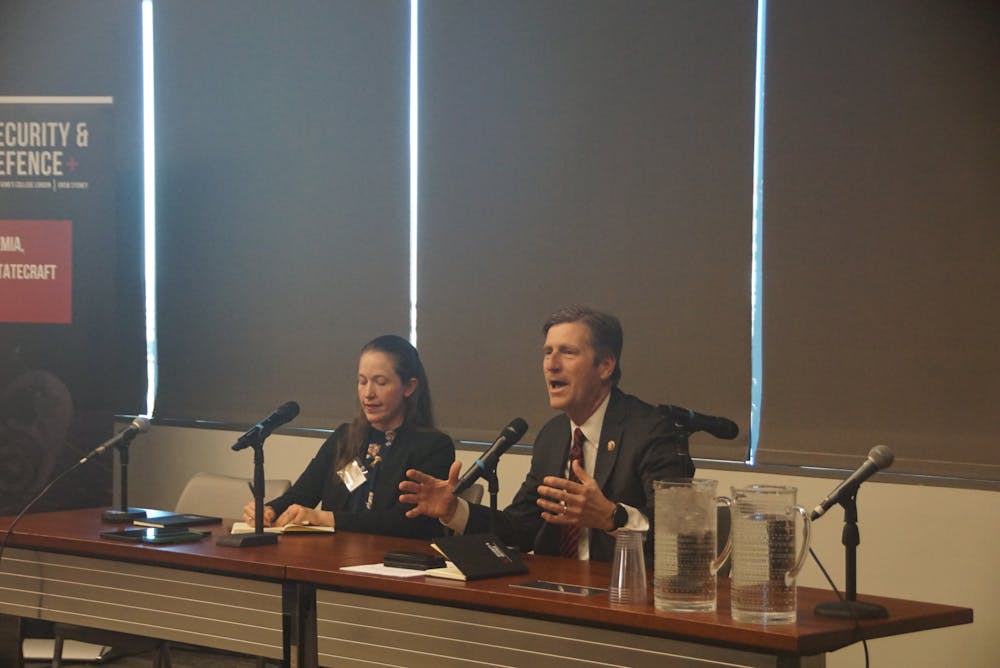
ASU and universities from Australia and the United Kingdom hosted a conference on the Tempe campus Monday to discuss defense issues and collaboration for global security.
Security & Defence PLuS, composed of ASU, King's College London and the University of New South Wales Sydney, held its Emerging Voices Series on Strategy, Security and Defence at the Fulton Center. Speakers included Arizona Rep. Greg Stanton, diplomats, military leaders, professors and students.
The Security & Defence PLuS program is part of the PLuS Alliance, which seeks to bring together the United States, U.K. and Australian universities to address global problems. The program specifically focuses on policy and statecraft in support of the AUKUS security partnership between the three nations.
The forum centered around global security and technology in the Indo-Pacific region, with an emphasis on the U.S., UK and Australian roles in innovation and collaboration.
The conference began with Stanton addressing the impact of security issues on the international, national, regional and local scales.
"I appreciate what the PLuS Alliance represents, bringing together the next generation of thinkers from across the globe," Stanton said. "This exchange matters, and I think we need it now more than ever."
Stanton praised ASU for its research capacity, which he said benefits the broader region and enables technological and economic development.
He also spoke about water security in the U.S., particularly regarding Arizona. Stanton said access to water resources allows for economic stability and growth in the state.
"Water security is national security here in Arizona," Stanton said. "Let me zoom out a little bit, because while Arizona fights an existential battle to protect our water security, the world isn't standing still."
Lily McElwee, the president and CEO of the Phoenix Committee on Foreign Relations, followed Stanton and discussed the U.S.-China relationship. McElwee said the U.S. and China are reorienting to compete with one another.
"We're now in a world where alternative architectures for problem solving and cross-border collaboration are becoming the norm," McElwee said.
McElwee added that cities and states must actively work together across borders and sustain international relationships within the changing technological environment.
During the conference, panels considered issues like the evolution of global alliances alongside technological advancement, AUKUS and semiconductor investment.
Several ASU students spoke during these panels and presented research they had conducted.
Peggy-Jean Allin, a research analyst for the Global Security Initiative at the University and a graduate student studying political science, said she researched Indo-Pacific diplomacy.
Wanting Lee, a doctoral student studying political science, spoke about experience with working for the Taiwanese government and research on the country's security.
During one conversation, Abraham Denmark, a former senior adviser to the U.S. Secretary of Defense, and Noelle Troutman, a political science professor at the University of Northern Iowa, discussed the role of AUKUS and the development of new military technologies.
Denmark said countries are rapidly deploying novel means of waging war.
"We're beyond the experimental stage," Denmark said. "We're now at the industrial scale stage of these advanced capabilities, and we need to be able to find the capacity and the innovative might so that we maintain the strategic edges and the tactical edges that we need in order to maintain deterrence and prevail in a conflict."
In one panel, speakers discussed how artificial intelligence can be used as a tool in both global and interspace innovation.
Laurie Leshin, a professor in the ASU School of Earth and Space Exploration, said in a panel that ASU is leading critical technological development with multiple applications, including in international security.
"ASU can play a role in helping to catalyze all of this," Leshin said. "Because it's important, civil space and the defense space need to be aligned — not integrated but aligned," Leshin said.
Edited by Carsten Oyer, Senna James and Ellis Preston.
Reach the reporter at ksmitten@asu.edu.
Like The State Press on Facebook and follow @statepress on X.
Kaitlyn Smitten is a politics reporter for The State Press. This is her first semester at The State Press. She previously served as a staff writer and correspondent for the Berkeley Beacon at Emerson College. She is a third-year Political Science major with a Writing, Rhetorics, and Literacies minor.