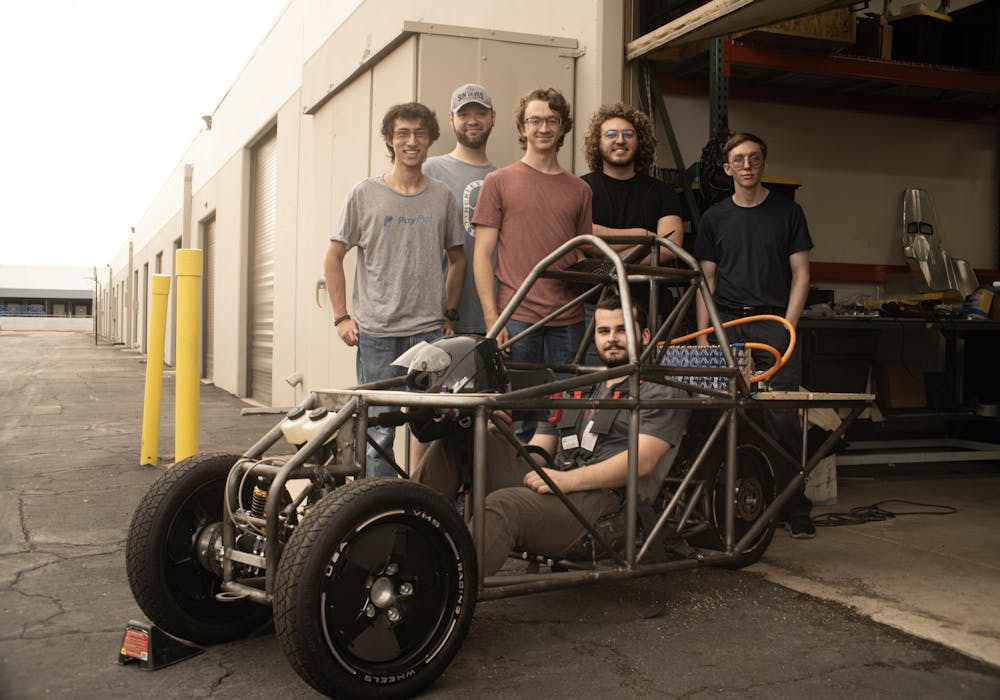
An ASU club is preparing to compete in a multi-day competition in a car powered by the sun and built completely by students.
Solar Devils focuses on building solar cars. This summer, they will drive in the Formula Sun Grand Prix, the track qualifier for the American Solar Challenge, according to Solar Devils president Boris Gershkovich, a junior studying mechanical engineering.
The American Solar Challenge is a week-long, cross-country race from Minneapolis to Amarillo, Texas. However, the Solar Devils will not compete in the American Solar Challenge to save funds.
For the Grand Prix, teams will be judged in the first part of the week based on the safety and performance of the car. Then, teams will compete to see which car can complete the most laps in 24 hours, spread out over three days.
"(We) build something sustainable, while also dealing with a lot of the challenges that come with building not really something that's a conventional vehicle," Gershkovich said.
The ASU team will take about 10-12 people, four to drive the car and the rest to help with repairs, according to Gershkovich.
"That challenge isn't really speed-based," Gershkovich said. "It's more, can your car make it the entire way?"
Solar Devils was a club in the early 90s at ASU, and was brought back about five years ago, Gershkovich said.
The team has been working on their current car for roughly five years, according to mechanical co-lead Jonathan Schaefer, a sophomore studying mechanical engineering. The car they use is entirely made by the students in the club.
Before the challenge, they sent extensive documentation about the car, how it meets regulations and its simulation results to professional engineers with the American Solar Challenge, Schaefer said. The process helps ensure the cars are safe to drive the long distance.
The car will be covered with around 256 solar cells, electrical co-lead Kai Valiensi, a sophomore studying electrical engineering, said. This year, the team has been soldering cells and working through solutions for charging the car's batteries.
The electrical side of constructing the car also includes protection systems such as brake lights, a horn and a radio for communication, Valiensi said.
Many of the essential parts, such as battery cells and a motor, are donated by other teams due to a lack of funding, Valiensi said.
"But hopefully if we ramp up and we show this year that we can actually do something, and we get more funding, we'll be able to buy that more expensive battery pack or that expensive motor to make a better car," Valiensi said.
Outside of the focus for the challenge, the club also does a lot of K-12 outreach and works with companies, Vice President of external affairs Andrew Lee, a sophomore studying mechanical engineering, said. This includes going to high schools to teach students who are in engineering classes about how they can apply what they learn in the classroom to real projects.
"We're just always looking for more opportunities to come and present our car and get younger generations inspired to do engineering," Lee said.
Solar Devils is not limited to students who are majoring in engineering, but is open to anyone who might be interested in building solar cars.
"We have a biomedical engineer, we have a civil engineer and we have people who are business majors, and they just want to join and be part of a business team," Valiensi said.
Now that they have a car to present and participate in the Grand Prix, Gershkovich said the team hopes that more students will be enticed to join.
Edited by Sophia Braccio, Jack McCarthy and Ellis Preston.
Reach the reporter at arive172@asu.edu.
Like The State Press on Facebook and follow @statepress on X.