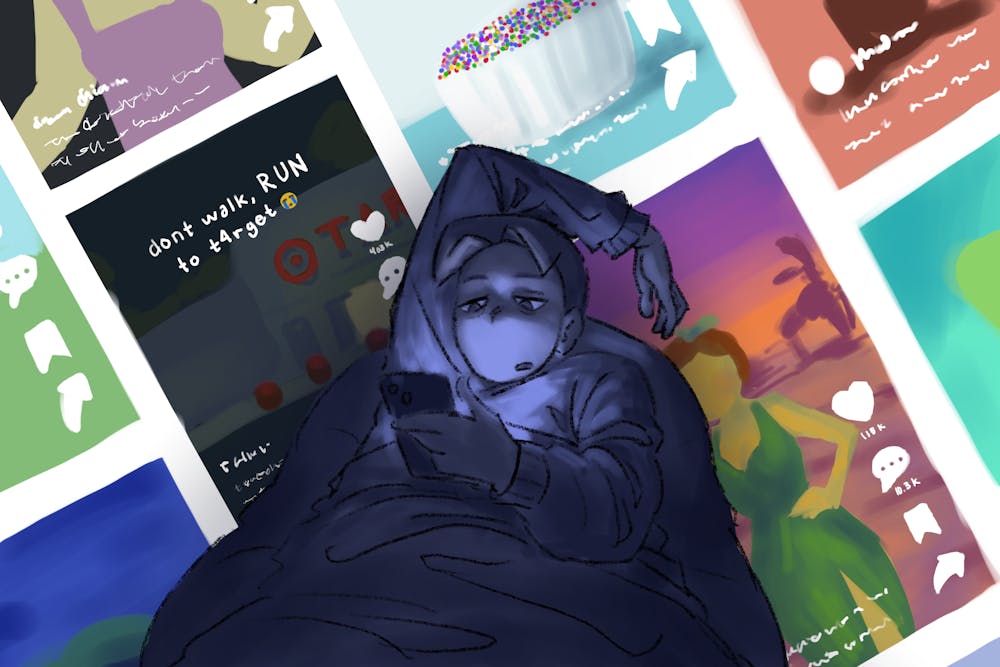
POV: A girl named Chanty Beluga ran (didn't walk) for the next episode of the AI Fruit Love Island series on TikTok while eating her dot cake.
If any of these buzzwords sound familiar, that's because all of these memes and trends have circulated heavily for a couple of weeks in 2026, then disappeared into the online black hole.
Through short-form video platforms, many trends can arrive in the blink of an eye and leave just as quickly. By the peak of their popularity, they're already old news, whether the trends are what people are wearing, new diets to try or what album is a must-listen.
Hannah Buttles, a senior studying psychology, thought fashion trends were the main genre consumers were following.
"They buy the clothes and the fashion and everything," Buttles said. "Then after it goes away, they're still like, 'Well, I still have these clothes. I still want this fashion.'"
She said a part of the problem with this kind of consumerism is fast fashion. Companies such as Shein and Zara follow the trending clothes, create them en masse and sell them to the customer for as cheap as they possibly can.
READ MORE: Fashion's dirty secret: Cheap clothing and its towering environmental cost
She also thought some trends would stick around longer than they did, such as dot cakes, the viral New York-based treats from Butterfield Market that people waited in line for hours over.
Andrew Stark, a sophomore studying theatre design and production, was glad to see some trends go away as fast as they did, such as the AI-generated Love Island series, which featured the contestants as sentient fruit.
His main issue with the trend cycle is how companies also jump on the bandwagon, and it is not always obvious that the video he is seeing is an advertisement.
Stark's issue with short-form content is that advertisements are now taking over people's algorithms.
"So now it's like you can't even get away from seeing it on your feed," Stark said.
Sometimes advertisements mimic content to a striking degree. Stark recalled seeing several ads in a row one night, unaware the videos he was watching were sponsored content.
"I thought it was very interesting how ads have started to become so synonymous with normal content that it's possible to go that long, potentially 20 minutes of scrolling, without even processing that," Stark said.
With how quickly trends move, companies need to keep with the times in order to retain their younger audience. Seventeen posts after Chanty Beluga — an online celebrity who gained fame primarily for her notable stage name — started her TikTok account, she had already struck a brand deal with Verizon.
Brands have tried to keep up with trends in many different ways, most notably on X or Threads, where brand accounts and government agencies have leaned into the gimmick of having Gen Z social media intern personas.
Sarah Steed, a sophomore studying nursing, spends around two to three hours a day on TikTok, and the trend cycle isn't a surprise to her.
"I feel like I'm just used to trends lasting a few days," Steed said.
She participates in dance trends and trending audios on her TikTok account. She's been following these trends for years and noted the practice isn't anything new.
Her specific example was the song "No Idea" by Don Toliver. She has seen the song reappear on TikTok every couple of years with people creating videos to a new part of the song each time.
Some feel that with how quickly internet conversations can change, it can be difficult to stay relevant socially without constantly gluing themselves to their phones. Because of this, the constant shift of pop culture can feel stressful.
"I feel like a lot of times ... if I don't go on social media for a day, people will be all in my face about one trend," Steed said.
READ MORE: Insight: I took a break from social media
Trends can be one of the easiest ways to come up with small talk in today's world. If two people are sitting next to each other in class with nothing in common, there is always a new trend everyone is aware of to spark up a new conversation.
While the new wave of microtrends can offer more ways to socialize, the manner of spending time online has taken a turn.
Scrolling seems to be less of a pastime, more of a necessity to stay relevant.
"You get excluded if you don't know what they're talking about," Steed said. "But then, three days later, it's something else. They change so quickly, and it can impact your everyday life."
Edited by Sam Troester, Alan Deutschendorf III and Sophia Keeling.
Reach the reporter at amahearn@asu.edu and follow @abiahearn on X.
Like The State Press on Facebook and follow @statepress on X.