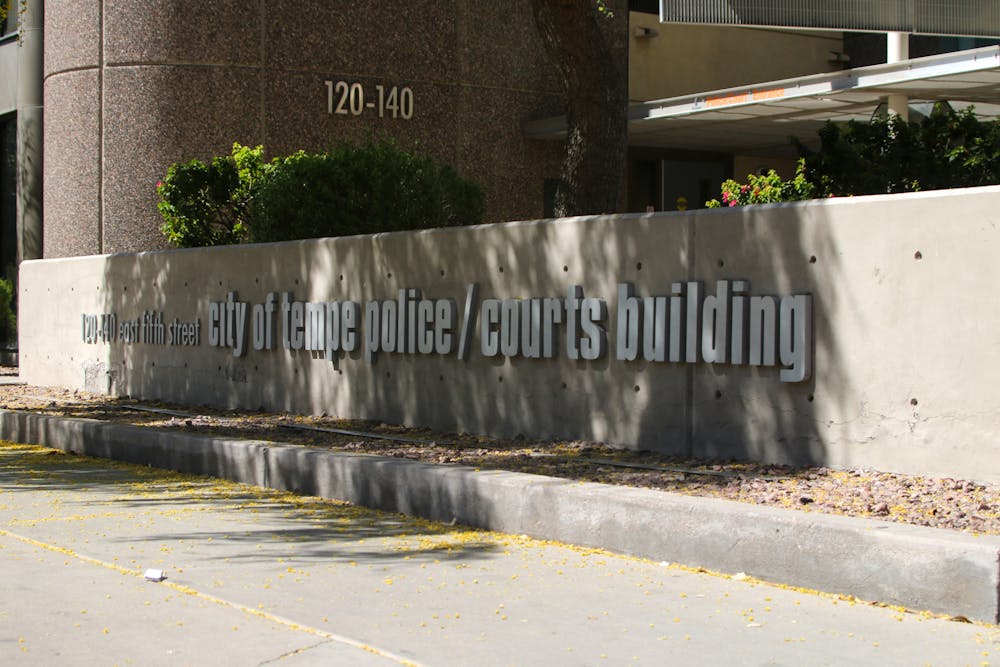
The Tempe City Council passed a measure Thursday to approve an updated $7 million contract with Axon Enterprise to purchase equipment for the Tempe Police Department, including body cameras, tasers and fleet cameras without automated license plate reader capabilities enabled.
The City Council was expected to vote on the original contract at the meeting on Aug. 31, but stopped after realizing ALPRs, automated license plate readers, were included in the deal. At the start of that meeting, Mayor Corey Woods said it was a clerical error, not a change in direction.
After city staff updated the contract's language, the City Council passed it in a 6-1 vote. Tempe will equip its police vehicles with a non-ALPR version of Axon's Fleet 3 cameras, a video system advertised for its mobile ALPR capabilities.
Councilmember Brooke St. George spoke in support of the contract. She said it is a consolidation of multiple contracts with Axon, which would save the city money.
"It includes a lot of things that we really do want our police department to have, including body-worn cameras, tasers and software to support real-time operation centers," St. George said. "For that reason, and because it is a significant cost savings to the city, and because we have decided to move forward with fleet without the ALPR technology enabled, I will be voting 'yes.'"
Only Councilmember Bobby Nichols voted against the measure.
READ MORE: What's new in Tempe: leadership, safety laws, nightlife
Despite the updated language, multiple attendees disapproved of the agreement. Tempe resident Kathryn Dorn worries about the city's ability to enforce non-ALPR use of the cameras and protect citizens.
"How badly do we really need the fleet cameras?" Dorn said. "What will they capture that a body camera would not capture that is genuinely necessary for public safety?"
Yegor Zenkov, an engineer who conducts research in Tempe, also spoke out against Axon, and said it is essentially the same idea as Flock Safety. Zenkov fears the contract will cause increased AI-use in police work, concentrate too many services under one vendor and cost too much.
"AI systems are inherently designed also to skirt accountability and auditability," Zenkov said. "I don't trust Axon; they were sued by their own shareholders for buying politicians and not telling the shareholders even who was receiving the donations."
City Attorney Eric Anderson said his understanding is that the city will purchase Axon Fleet 3 cameras without the ALPR technology add-on. However, according to the Axon website, ALPR is a subscription service that can be activated on Fleet 3 cameras at any time.
The Axon contract's only official reference to ALPR technology is three words — a parenthetical that says fleet cameras and support services will be "not ALPR enabled."
Axon did not reply to a request for comment.
In an interview after the meeting adjourned, Nichols expressed his disappointment with the vote.
"I'm worried about the potential of this technology being used in a way that is unsafe, especially because these third-party, private entities have a really bad track record of protecting the data that they take into their data sets," Nichols said. "Ultimately, they're required to sell that data in order to make money to take care of their bottom line, and it really creates a financial incentive for abuse of our privacy rights."
Nichols said he is concerned about Axon in the same way he was concerned about Flock Safety. The city turned off its Flock ALPR cameras Aug. 26 and announced it would end the contract without seeking a replacement vendor.
READ MORE: Flock cameras to remain on ASU campus after Tempe shuts down its system
Privacy concerns are a product of ALPR companies' business model, he said.
"That financial incentive, again, it's inherent in the ALPR business, and I don't really think there's a way to safeguard around it, even if these companies are as benign or positive as possible, which they are not," he said.
Nichols said he is working on an ordinance that would ban all ALPR technology from the city of Tempe.
Edited by Carsten Oyer, Emilio Alvarado, Senna James and Sophia Keeling.
Reach the reporter at sevoorhe@asu.edu.
Like The State Press on Facebook and follow @statepress on X.
Sydney Voorhees is a Senior Reporter at The State Press. She is also an intern at Arizona PBS and a member of Delta Gamma Fraternity. This is her second semester with The State Press, working previously as a part-time Sci-Tech reporter.