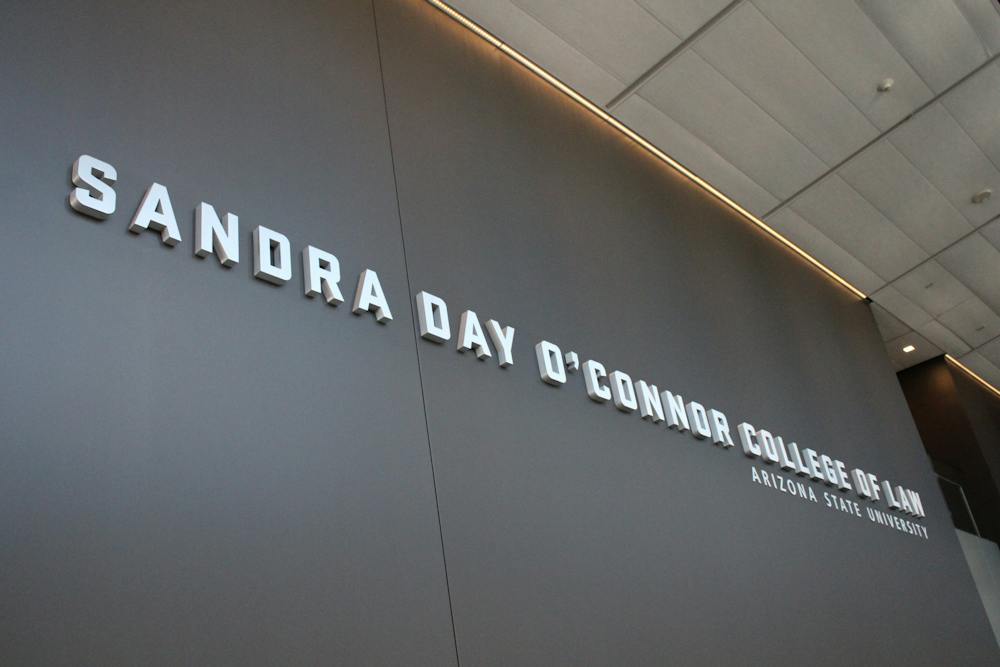
The Indian Legal Program at ASU's Sandra Day O'Connor College of Law gives students with an interest in Indian law the opportunity to work closely with Native American staff, students and local tribes.
By partnering with Native American faculty and local tribes, students can learn about tribal law, and the program is open to students with interests in the area.
Part of the Indian Legal Program is the Indian Law Certificate Program. According to the program's website, the certificate program is aimed at students who are planning to represent tribes directly after graduation.
Kate Rosier, a member of the Comanche Tribe, is the executive director of the Indian Legal Program and the college's assistant dean of institutional advancement.
She said the University has taught Indian law since it was established.
Before becoming an official program, U.S. Court of Appeals Judge William Canby, also a law professor, offered basic tribal law classes to local tribes. After this, ASU law students LynDee Wells and Gloria Kindig worked with their dean to establish a formal program.
The Indian Law Certificate Program was officially offered starting in 1988.
"They thought it was important that the law school formalized its relationship with tribes and the intent to focus on Indian law within the law school," Rosier said.
Another initiative at the law school, the Tribal Nations Policy Institute, recently changed its name from the American Indian Policy Institute to better reflect the tribal nations and governments it serves while continuing to work alongside tribal communities, according to the law college.
She said students from across the country are drawn to the program because of its large number of Native American faculty members and students who are able to work directly with different tribes.
Arizona is home to 22 recognized tribes. Rosier said this uniquely positions students and faculty to work closely with local tribes to gain practical experience in the field.
"We're very close to some tribes, and so students can do work for them after class or set up internships, do stuff during the summer, participate in some of their activities," Rosier said. "It is a really great place to be if you are interested in Indian law."
Among the topics covered by the certificate are Indian gaming, cultural resources, tribal government and international indigenous rights.
Ann Bledsoe-Downes, a member of the Winnebago Tribe of Nebraska, is a professor of practice and director of Indian gaming and self-governance at the law college. She said Indian law covers a diverse range of interests.
"Indian law is everything," Bledsoe-Downes said. "It's healthcare, it's roads, it's social services, it's education. There's no area of law where Indian law doesn't intersect."
Robert Miller, a law professor and citizen of the Eastern Shawnee Tribe, said the program has helped graduate 400 Native American lawyers since the 1988.
READ MORE: ASU Law developing Indian gaming and tribal self-governance programs
The professor said there are only about 3,000 Native American lawyers in the country, and the University has helped graduate around 15% of them.
"Our graduates are all over the country," Miller said. "They're making a major impact in representing tribes and protecting tribal sovereignty."
Miller referred to the Indian Law Certificate Program as the "leading Indian law program in the country."
Tribal law pertains to every area of life, Miller said. While tribe sovereignty, governmental action and criminal justice are commonly thought of, tribes also offer crucial social services.
Bledsoe-Downes emphasized that local tribes actively work with county, state and federal government, making Indian law crucial to communities.
"Healthy tribal governments and robust legal offices supporting those tribal governments create for good relationships with state and local leaders just trying to improve their communities around them," Bledsoe-Downes said.
Edited by Andi Ruiz, Emilio Alvarado, Grace Lawrence and Carsten Oyer.
Reach the reporters at lnatiell@asu.edu.
Like The State Press on Facebook and follow @statepress on X.
Leticia Natiello is a politics reporter at The State Press. She is a second-year journalism student at the Walter Cronkite School of Journalism and Mass Communication at Arizona State University. This is her first semester with The State Press.