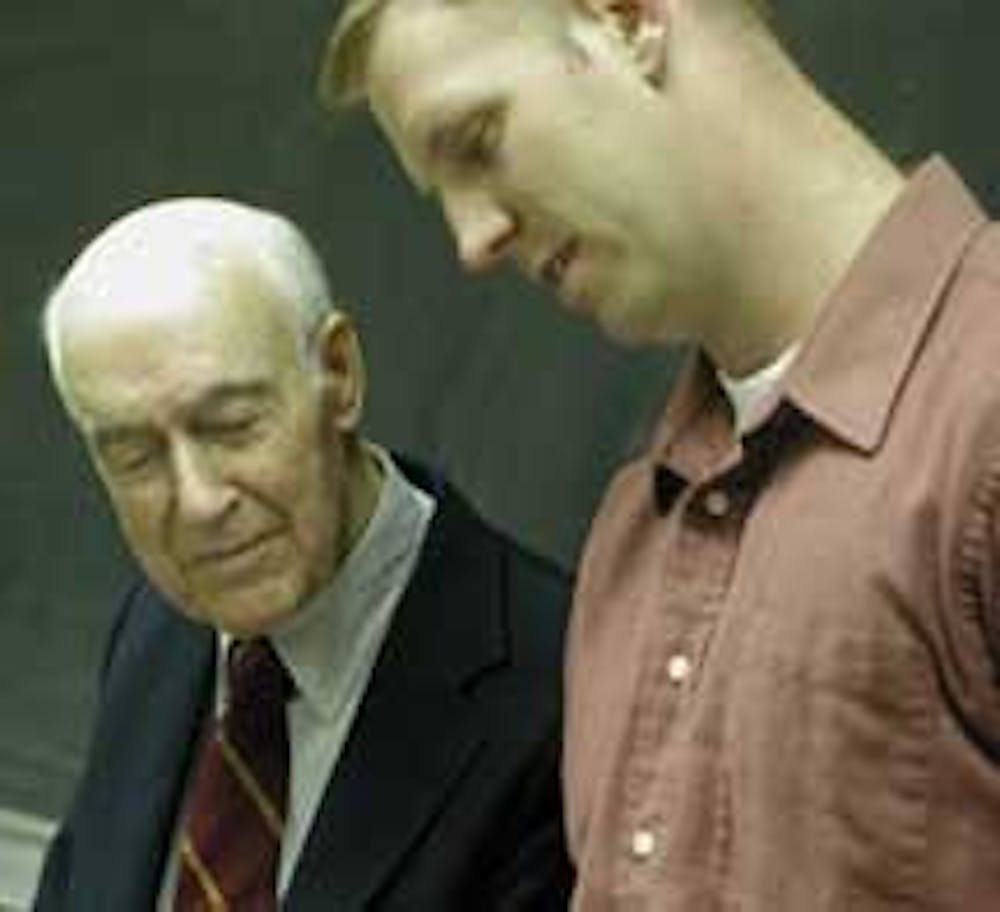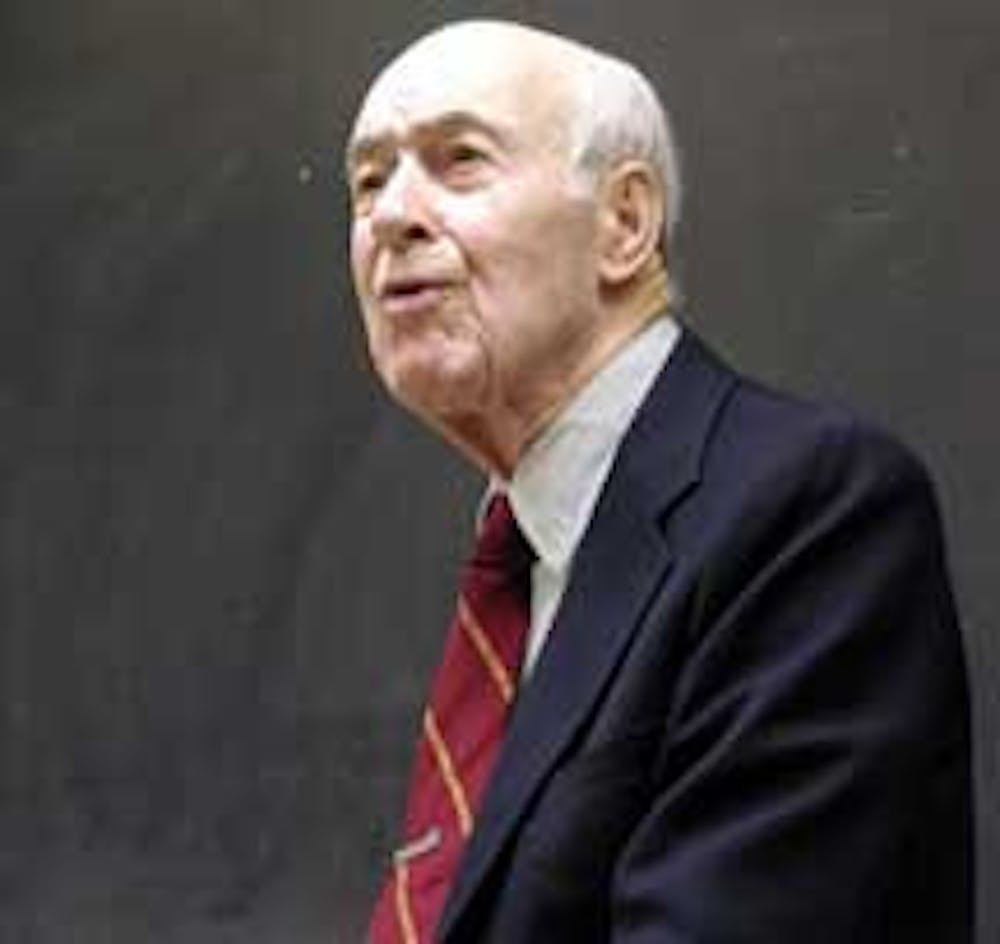
Professor Frank Sackton claims to be way beyond retirement age.
At 91 years old, he isn't lying. However, Sackton isn't anywhere near quitting age. He can still fly up a staircase like an undergraduate and his handshakes still make students' hands numb.
Blessed with the gift of longevity, Sackton figures to stick around with his students at ASU a while longer. He believes there's too much knowledge, too many ideas, being shared on campus to leave.
As mentor to many students over his 25 year career as an ASU faculty member, Sackton doesn't want to miss taking part in the exchanges which drew him to education in the first place.
Sackton first came to Tempe as a ASU graduate student in 1975. Four years later, he became the founding dean of the College of Public Programs and, in 1997, Professor Emeritus.
During his ASU career, Sackton has served as vice president for business affairs, director of affirmative action, and director of athletics, in addition to holding many other titles. He's taught graduate-level courses in bureaucracy, public affairs, governmental budgeting, finance and management.
"A lot of ideas, a lot of capacity, is embedded in longevity," Sackton said. "If you stick around long enough, things happen."
Plenty has happened to Sackton, and he shares much of it with his students. But more striking than any titles of distinction he earned while teaching, Sackton's former title of lieutenant general in the U.S. Army draws the interest of his students.
Sackton survived the South Pacific jungles of New Guinea and Luzon, amongst others, as he commanded soldiers against the Japanese during World War II. He retired from the military as a three-star general after 35 years in the military.
During the Luzon campaign, Sackton received a promotion to colonel while combat operations were ongoing.
Mentoring replaced career of violence
Sackton casually explains how he went from fighting on the battlefield, to lecturing in the classroom.
"My major career was in violence and destruction," Sackton said. "When I came to the university, I found the atmosphere to be one of mentoring, construction rather than destruction... helping people rather than killing them."
Sackton said he makes himself available as a mentor, particularly to his graduate students who will seek careers in public administration, financial management or budgeting.
"I think the trick to teaching isn't to regurgitate the classic literature," Sackton said. "They're adults. They can read and observe. You (as a teacher) have to, operationally, put it into meaningful terms."
As he teaches, Sackton draws from his personal experiences in the realm of military administration and management to better facilitate the learning process. He is humble, and rarely mentions his relationship to the legendary five-star U.S. Army general, Douglas MacArthur.
MacArthur's In-and-Out Basket
After the atomic bombs were dropped on the Japanese cities of Hiroshima and Nagasaki, the U.S. immediately sought to occupy the country. Gen. MacArthur was appointed Supreme Commander for the Allied Powers in Japan, and set up his headquarters in Tokyo.
Sackton was appointed secretary of MacArthur's staff and worked very closely with the general throughout the reconstruction of Japan. He coordinated staff efforts to organize the many American and Allied troops stationed in Japan during the occupation.
"(MacArthur) had no in-basket or out-basket," Sackton said. "I was both. I used to see him three times a day. He had some idiosyncrasies which I think historians have misinterpreted.
"For instance, he would completely drain a message of it's content while pacing the floor. He sometimes thought there was a hidden message, or nuance, in the cables we received. It was just that he had the knack of throwing himself into any case. He could read into a case and foresee the unintended consequences."
Sackton has been published over 285 times in his life. He wrote an in-depth personality profile about MacArthur for Army magazine and has written dozens of columns about U.S. foreign policy.
Most recently, a commentary he wrote about Arizona's budget problems was published in the East Valley Tribune on Nov. 26.
Oddly enough, for a man with a resume as thick as a textbook, Sackton volunteered to teach an undergraduate course this semester. His "Democracy and Ethics" course isn't as philosophically thick as the graduate-level "Preparation of Reports in Public Administration" used to be, but students are still benefiting from his experiences.
"You have no idea what a war hero you have here"
Sackton invited a guest speaker to lecture in the final Democracy and Ethics class on Dec. 3.
Also an Army soldier during the U.S. campaign in the South Pacific, retired Col. A. Park Shaw stunned his Sackton's students by listing his comrade's achievements during World War II. Some students had no idea while others nodded in accord.
"It's an honor for me to have (Sackton) as a friend," said Shaw, who is state president of Arizona for the Association of the U.S. Army. "You have no idea what a war hero you have here."
Kevin Haynie, a junior public administration major, understood about Sackton's past.
"He doesn't talk much about his personal experiences," Haynie said. "He's very humble in that way. He approaches you as a professional."
Sackton said he doesn't need to have students approach him for "war stories" in order to feel gratified about teaching them.
"I'm very high on the youth of America," Sackton said. "This is a great generation coming up. I've seen a lot of visible leadership, especially in the classes I've studied with."