Listen to the article:
Content warning: This story contains subject matter that may be disturbing or upsetting
to some readers, including suicide, self-harm and violence. Please proceed with caution.
Editor's note: Names of people in this story have been changed for privacy.
I walked down the plain, sterile hallway, a nurse beside me. The walls were not completely blank, but they may as well have been, decorated occasionally with the type of generic photos a dentist's office has to make terrified patients feel less trapped.
Perhaps that was the purpose here as well, though I was not at the dentist. It was an early afternoon on Dec. 22, 2021, and I was being led to my unit at a behavioral health center in Tempe. It was a psych ward, a mental hospital, whatever you want to call it. I liked to call it "the looney bin" because taking any part in this situation horrified me, and pretending it was funny gave me some solace.
The facility and its patients
As I entered my unit for the first time, I observed my surroundings closely and nervously. There was a long hallway lined with bedrooms, a room for group therapy at the end and a nurse's station in the middle. The other patients sat in the hallway, and I noticed immediately that some were playing UNO. At that moment, I didn't care much for card games. I walked into my new room and cried my eyes out instead.
In a unit accommodating 13 to 17-year-olds, I was one of the oldest patients there, and also one of the few there mostly on my own accord. I was suicidal, and after a disastrous 17th birthday in November, I knew I needed more help than I was getting. But as I lay in my uncomfortable new bed for the first time, the contentment that I felt upon my arrival eroded. I was a mess.
Since we were not permitted to close our doors, I periodically heard other patients talking about me. About my sobbing. About my refusal to come out. Eventually, they left for lunch, and because I hadn't seen the psychiatrist yet, I wasn't allowed to leave the unit. Instead, food was brought to me. While my grilled cheese was slightly burnt, I gobbled it down happily and rather thoughtlessly. I was just happy it was edible.
For a while, I enjoyed the quiet of my fellow patients' absence, but once they came back, I stifled my tears and introduced myself. There was a variety of people in the hospital, and most were there either for suicidal ideation or drug detox. One person, Jacob, seemed to take an interest in me. He was the only other 17-year-old patient and appeared to be a leader among everyone else.
He asked me questions so everyone could get to know me. While I've forgotten most of them, I do remember him asking about my dress. Typically, new arrivals in a psych ward have to wear scrubs on their first day while the hospital examines their clothes for any dangerous hidden objects. However, they had no extra scrubs when I arrived, so I had to wear a green gown — one that revealed my underwear when I sat with my legs crossed like everyone else.
Jacob showed me how to play UNO with the unit's rules and even taught me some strategies. He was the first person to make me feel comfortable there and always displayed kindness and thoughtfulness. And yet, I learned Jacob was in the hospital because he had allegedly planned a school shooting. He became an elusive figure to me, one whom I tried and failed to fully understand.
What I could gather was that, despite allegedly plotting such a heinous crime — and by his own admission struggling to feel empathy — he was at the very least a far more complicated individual than I could have ever imagined.
Jacob detested authority, which contributed to many of his predicaments over the course of our time together. Many times, he delayed our breakfasts — and sometimes our lunches — by refusing to get out of bed, sparking a great war. Sometimes he would surrender and get up, and others, the staff would surrender and let him sleep.
Most of my peers were not so rebellious, and there were about a dozen of us at the start. Ethan and Ryan were two I instantly liked. They were also in the unit for mental health reasons. Ethan was outgoing enough to bring me out of my shell, even if just a little. Ryan and I had the same music taste, which gave us something to talk about. Maddie was the youngest, just 13 years old, there for both suicidal ideation and drug detox.
Emma, whose situation was perhaps the most severe of them all, was a girl scarred both physically and emotionally. She had been in the facility for almost 50 days preceding my arrival. Patients usually stay at a short-term facility like ours for seven to 10 days. A two or even three-week stay is not unheard of, but 50 days in that place is unimaginable to me, especially at 15 years old.
By my second night, Emma broke. I was adjusting, though I still seldom talked and felt like an outcast. I had my first psychiatrist appointment after waiting 24 hours and finally got my own clothes back, which was a big deal for me. My clothes are a part of my identity, so being able to throw on my Pearl Jam shirt helped me feel a little more like myself.
After our nighttime group therapy session, everyone lined up to get their vitals taken. The nurses did this every morning and night, a standard procedure at psych wards. I was toward the back of the line, watching with boredom as each person sat down in the chair, got their vitals taken and then was released.
Once it was my turn, I sat down in the chair, facing the hallway. The nurse applied the blood pressure cuff on my arm and the thingy on my index finger to measure whatever that thingy measured. I tried to unnerve as the cuff tightened. The nurse was bent over, and I saw Emma slowly walk up behind him. By the time she grabbed a set of keys out of the nurse's pocket and bolted in the opposite direction, I was still trying to register what was happening.
She ran for the large wooden door kept locked unless we were being escorted. That was her exit. To get there, she had to make one turn in our unit, which was mostly one long hallway. As she attempted to change direction, one staff member tackled her to the ground, and several others joined to restrain her.
They held her in place and she screamed. It's a scream that still echoes in the back of my mind and haunts me occasionally to this day. It was guttural and painful — the kind understandably uttered by a 15-year-old girl trapped in such an enclosure.
I was horrified, but my peers were indifferent. They told me it happens all the time. And they were right. I heard that scream several more times, and I, too, became desensitized to it eventually. Regardless, I was alarmed by the extreme issues people much younger than I faced.
Of course, I was just two years older than Emma and four older than Maddie, but at the time, I thought of them as children and myself as an adult. (Re-reading the journal the hospital provided to me has revealed that I was absolutely still a child at 17.) It didn't escape me that the youth captured within my peers made for a disturbing contradiction to the grave lives they managed to live in that time.
Some of them (I worried myself by theorizing) might never become adults. It was a thought that haunted me whenever I glanced around at those cursed with both the innocent eyes of children and the battle scars of adults. On the night before I left, the staff found a sharp metal sign in Emma's room, pulled from one of the walls. I don't know if this was intended for self-harm or suicide, and I've always wondered how she managed to get it in without anybody noticing.
Perhaps she had some elaborate plan informed by her incredible knowledge of the facility. Or maybe stealing the sign without interference was the kind of dumb luck that can only be willed by pure, unfiltered desperation. Either way, the discovery of this sign prompted the last — and to my memory the most extreme — of Emma's breakdowns.
To my shock, she was still there when I left, though there was a plan for her to depart the day after I did. Not to go home, of course, but to go to a facility designed to keep patients for several months. I hope she went, and I hope she found remission there.
Learning to cope
By Christmas, I was feeling about as good as I could, given the circumstances. My first roommate — an interesting character in his own right — left a day earlier, temporarily giving me my own room. This worked great for me, and while I still complained in my journal about things like the inaccessibility of dental floss and never being let outside, I was mostly content. I socialized more and became more acquainted with those I spent my time with.
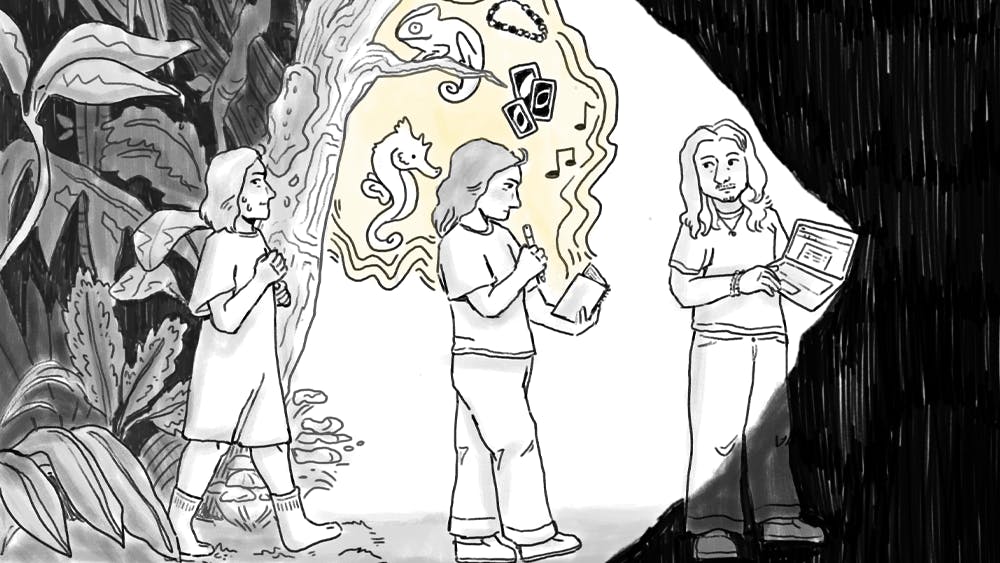
My main focus in my free time, however, was my artistic endeavors. Coloring pages are a staple in psych wards, and mine were bright and multi-colored, almost psychedelic. My proudest works were a seahorse and a chameleon, each intricate and detailed with a variety of colors, taking multiple days to complete.
My most enduring artwork from my time in the hospital was a bracelet, created one day in art therapy. I rotated between yellow and black beads with lettering in between, reading "There’s no rain." It was a reference to Blind Melon's "No Rain," my favorite song, which I had been ruthlessly deprived of since my intake.
The song was written by the band's bassist from the perspective of his girlfriend, who had depression, and I adore it. Music has the wonderful ability of making me feel seen amid my most troubling emotions, and "No Rain" was the very first song to give me that experience. The hospital took that bracelet from me when I finished it, but returned it upon my discharge. Four years later, I still wear it on my wrist every day.
Art has many therapeutic qualities, and I highly recommend it for that purpose. However, the more traditional talk therapy I received during this time was lackluster, and my new medication was slow to start working. When my unit was spontaneously combined with another, I wasn't equipped with the tools to handle the change.
I became suicidal again — a rapid change in mood from how I felt just a few days earlier. When I finally went home on Dec. 30, I was not much better than I was when I came in. In fact, I was worse. Before my first trip to the hospital, my self-harm consisted of things like scraping myself with the rough part of the velcro on a baseball hat. Within weeks of leaving, I was cutting my arm open with knives.
The scariest part was that it worked. I deeply hated myself, and I wanted to punish myself for existing. It felt rewarding, in a way, to do that. On Feb. 23, 2023, over a year after my first hospitalization, I attempted suicide. I was a senior in high school, just months from graduating. Yet those three months felt like a lifetime when I believed it would truly be the death of me.
First, I started ditching classes, something I had never done before. When that proved to be as little of a real solution as I knew it was deep down, I was out of ideas. During my dreaded chemistry class one day, I went to the nearest bathroom and locked myself into a stall. While this was a routine process for me when I self-harmed, that day was different. I wanted to die.
Or maybe I didn't, but I knew for certain that I no longer wanted to be alive. Thankfully, that was not the last day of my life. It was, however, my last day of high school. I dropped out, and replaced my schooling with a Partial Hospitalization Program, or PHP, which allowed me to receive intensive therapy during the day and go home at night.
While my first hospitalization introduced me to a whole new world of intensive mental health treatment and the people who received it, PHP was where my life actually started to turn around for the better. I was educated in the methods of Dialectical Behavior Therapy, which fundamentally reshaped the way I thought.
Before DBT, much of my depression stemmed from feeling constantly haunted by the guilt of many minor regrets in my past, which I had exaggerated in my mind. The strategy of "radical acceptance" helped me come to terms with the reality that my past was out of my control. When I feel depressed about these regrets, radical acceptance taught me to repeatedly remind myself that it's in the past, and that there's nothing I can do about it except learn from my mistakes.
The second strategy, "wise mind," taught me how to stay rational in emotional situations — a balance of the emotional mind and the analytical mind. This strategy proposes that in a stressful situation, you should think of what the purely emotional and purely analytical responses would be, and then determine a "wise mind" solution that takes both responses into account without giving in to any extremes.
I never graduated from high school, a fact which did and still does cause me sadness. I never got the opportunity to walk across that stage with my friends, or hold up my diploma as my family cheered. Yet not long after I graduated from PHP, I took and passed my GED exams, allowing me to go to ASU as planned.
I owe much of my progress to the DBT skills I acquired, as well as my unrelenting passion for music and the arts, which provided me with as much fuel as food does. Along with “No Rain,” many other songs have since helped me understand and contextualize my own struggles with my mental health.
My second-favorite song is "Lithium" by Nirvana. Named after the mood stabilizer, it's a song about violent mood swings and the highs and lows that accompany them. That's a fact I first learned from my friend Ryan on Dec. 26, 2021, within the confines of a behavioral health center in Tempe.
If you or someone you know is struggling with mental health, visit 988lifeline.org or text 988 for help. For campus resources available 24/7, visit https://eoss.asu.edu/counseling. ASU's EMPACT line is 480-921-1006 and is available 24/7.
Edited by Leah Mesquita, Natalia Jarrett and Abigail Wilt. This story is part of The Expression Issue, which was released on October 8, 2025. See the entire publication here.
Reach the reporter at evansilverbergrep@gmail.com and follow @evansilverbergwrites on Instagram.
Like State Press Magazine on Facebook, follow @statepressmag on X and Instagram and read our releases on Issuu.
Evan Silverberg is a reporter for the State Press Magazine. Specializing in coverage of social Justice issues, he has published several deep-dives into hard-hitting topics affecting the ASU community. He is in his third semester with the State Press and has been recognized by the Society of Professional Journalists with a Region 11 Mark of Excellence Award nomination.