AI impacts everyday life in ways unheard of just a decade ago.
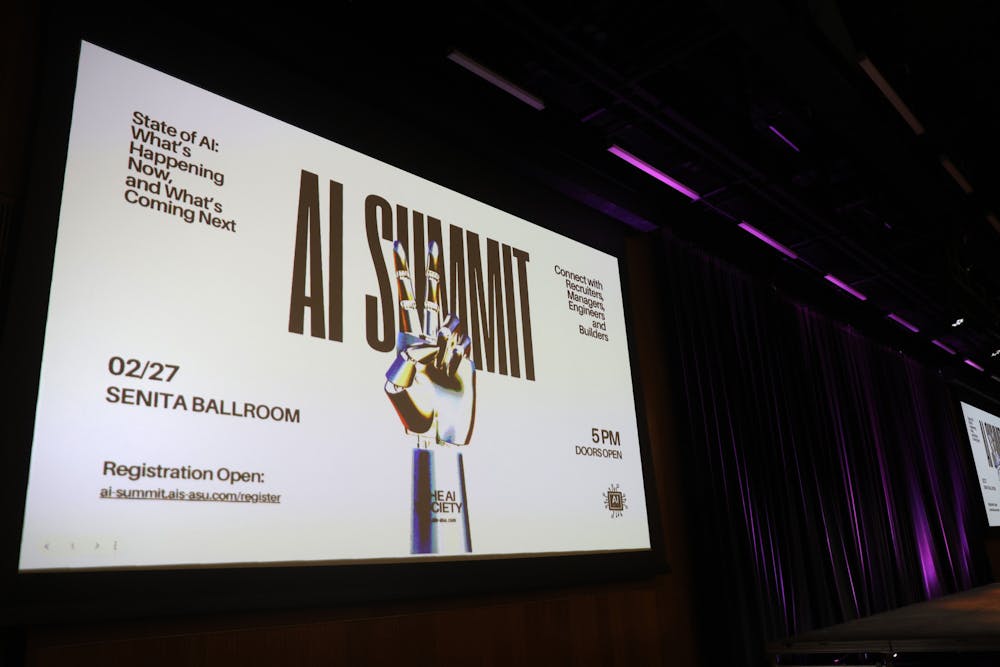
The AI Society at ASU hosted its first AI Summit on Feb. 27. The largest student-organized AI event at ASU connected students with professionals and organizations that use AI across various industries to optimize and innovate within their businesses.
The combination of speakers and networking created a unique, welcoming setup. Round tables spread around the room invited students to collaborate, introducing a welcoming atmosphere from the jump.
Siddharth Mehta, the vice president of The AI Society and a graduate student studying computer science, opened the summit by challenging participants to "walk away with at least four meaningful connections."
On the far side of the room sat businesspeople ready to welcome in students wanting to learn more about AI advancements. This network is a big part of what the AI society prides itself on.
"We are a community of researchers and builders," Mehta said. "We are the ones that take action."
READ MORE: Experts discuss the growth of AI, how Sun Devils can become more AI literate
Following the speech, participants made their way over to the variety of companies, ready to dive into the wealth of research shared by these corporations.
One business was RunBuggy, a transportation startup based in Tempe. While AI is not an integral part of their business model, they found it to be beneficial for the optimization of day-to-day operations.
"We've consolidated, streamlined (logistics) with our natively built platform, which we use AI to optimize the entire experience, taking OpenAI's AI libraries and pointing them at our millions of data points that are out there," Jason Kong, the senior vice president of operations at RunBuggy, said.
Kong attended the event representing RunBuggy to connect more with students attending the University, as the company's proximity to the Tempe campus creates an ideal relationship for both students and the company.
"We have almost 200 people in the company right now but have an extreme growth trajectory," Kong said. "(We're) looking to bring people in to help get a deep relationship with ASU."
RunBuggy was not the only company at the summit; Perplexity, ForgeOpus, Anthropic and MPS-Lab, among others, also attended the event to showcase new technologies and interact with students.
Between networking sessions, the AI Society welcomed speakers from the workforce to highlight their businesses and the growth of AI within their companies. One speaker, Patrick Barragán, provided detailed information about his company, Samsara.
Samsara is a multifaceted company that uses AI to observe and analyze driving to create better conditions and road safety. The company's technology is used throughout the United States, working across an exponentially growing field of drivers.
"Every single time that I'm able to improve road safety for a single driver, in Samsara, that gets multiplied by millions of devices that are all across the country," Barragán said.
With the accumulation of data, he said Samsara can utilize its interconnected network in ways that individuals could never accomplish on their own.
The Samsara customer database of 20,000 has led to 20 trillion data points to be processed. This is where AI comes into play. Barragán uses AI to analyze these data points and spit out results that can significantly increase driver safety when implemented.
READ MORE: ASU lab embeds AI into wearable medical systems
With these advancements, there is a learning curve for implementing AI into everyday life. One big part of that is in the classroom. While it will take time, Kaustubh Harapanahalli, the AI Society co-president and a doctoral student studying computer science, said AI has an immense impact on how universities approach learning.
"How we think about using AI should change, and I think it has changed a lot compared to the last two years," Harapanahalli said. "We need to go all in into it, and then that is going to create different kinds of opportunities."
Overall, these companies have seen AI as a tool for optimization, process improvement and processing speed. These innovations are being made at a level that is unprecedented in the technology space, and will continue to improve exponentially for years to come.
"Just from our own investments, we've reinvested $2 billion into our own (research and development)," Barragán said. "Things are only accelerating."
Edited by Kate Gore, Senna James and Ellis Preston.
Reach the reporter at aldeutsc@asu.edu and follow @AlanDeutschend3 on X.
Like The State Press on Facebook and follow @statepress on X.
Alan Deutschendorf is a Managing Editor at The State Press. This is his fifth semester, and he previously worked as a sports editor and sports reporter. Alan also works as an event assistant at ASU Health and spent two years playing D1 club roundnet.