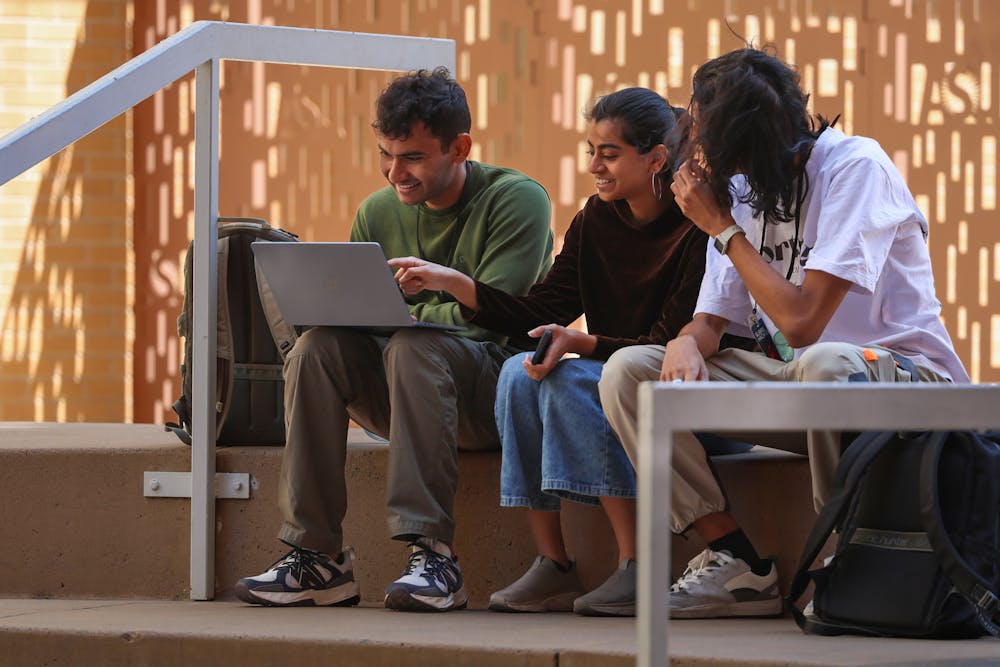
ASU recently hosted the Globehack go-to-market hackathon, where students spent April 18-19 acting as "zero-cost consultants" to companies facing business challenges.
According to Globehack's website, the event was the first go-to-market hackathon in Arizona. While participants walked away with experience solving real-world problems, the companies walked away with dozens of potential solutions at a fraction of the cost.
The competition featured four main tracks and four side tracks sponsored by different companies, all presenting students with various prizes based on their ranking. Global Career Network hosted the event, and GCN President Misa Tran, a junior studying supply chain management, said the organization connects students with jobs and opportunities to showcase their skills.
"We try to partner with a lot of companies and then bring them on campus to create a bridge connecting between them and the students," Tran said. "Students can have a chance to network, and then hopefully a job or interview with the company partners."
READ MORE: Why hackathons dominate ASU's student tech scene
Hackathons tend to promote good opportunities and experience, but for students like Reuben Roy Kochukudiyil, a graduate student studying software engineering, hackathons like this one raise questions about whether companies are "taking advantage" of the current situation in the industry.
Kochukudiyil said if companies were to hire a team of engineers to solve a problem, they would face costs in the thousands. At events like Globehack, they only have to spend a few hundred dollars in prizes to receive many potential solutions.
"If you go to a hackathon ... you can probably have 30 versions of the same product and have the students ideate and come up with everything for you, and you can just pick the one that you think is the best," he said.
Kochukudiyil said this model is "awesome" for the companies, and students can still benefit from the experience and look into problems they wouldn't have otherwise. He added that hackathons bring together some of the most innovative students from ASU.
The event attracted many students with coding and software backgrounds, including Dhruvik Asmani, a graduate student studying computer science. Asmani said his participation allowed him to put the theories he learned in class into practice.
Asmani said his project was centered on Trucker Path, which aims to improve truck and driver productivity and safety. He said the organization's problem statement said it has to manually manage each vehicle's location, working hours and schedules.
To remedy the issue, Asmani's team developed a system that could automatically retrieve information about the drivers and trucks with a single click.
"It will calculate each driver's potential, and it will give you the best driver, as well as truck," he said.
READ MORE: One of the biggest hackathons in Arizona returns for its eighth run
Another company at the event was Vector, an app builder marketed to early founders without technical backgrounds. Nick Shaw represented Vector as a judge for the competition.
"Coding without a market is just a hobby, so our goal at Vector is to really enable anyone to start a business — software, AI business —and really take that to the real world in a matter of days," Shaw said.
He added that Vector was interested in attending Globehack because of its focus on entrepreneurs, a core value at the company. The prize for the winner of the Vector track was a fellowship, and Shaw said he noted the conviction of the "next generation of professionals."
"We just love the energy from this generation, and really just want to continue to push them to make the most of ... the opportunity at hand with new technology," said Shaw.
Edited by Kate Gore, Henry Smardo and Pippa Fung.
Reach the reporters at dforres5@asu.edu.
Like The State Press on Facebook and follow @statepress on X.